
The Seven Walls of a Brand Manager’s Mental Prison: A Story of Slow Professional Decline – (Brand Management 85)
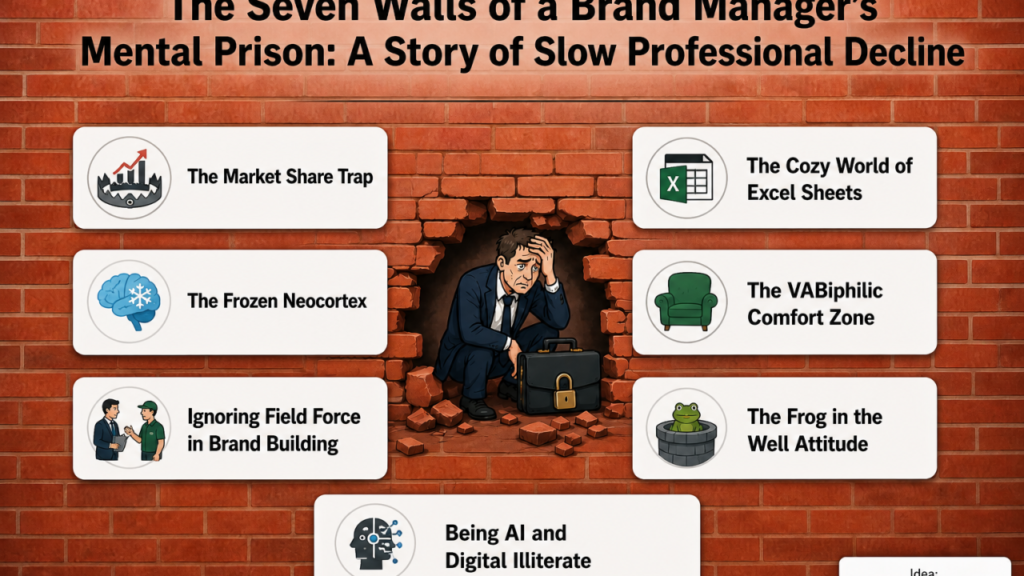
Jaganath Shetty had everything going for him, six years of experience, a respected role as a Senior Brand Manager at Canopus Pharma, and a brand that wasn’t failing… but wasn’t flying either.
From the outside, it looked stable. From the inside, it was a prison.
Not a prison of walls and bars—but of thinking. Seven walls. Built slowly. Brick by brick. By Jaganath himself.
Wall One: The Market Share Trap
Every morning began the same way—numbers, ranks, percentages. “3% more… just 3% more.” He wasn’t building a brand anymore. He was chasing a number. And in that chase, he forgot a simple truth: real growth doesn’t come from fighting for a slice—it comes from creating a new plate altogether.
Wall Two: The World of Excel Sheets
His world lived inside spreadsheets. Clean. Predictable. Safe. But outside, in clinics and corridors, real stories were unfolding—unheard, unseen. Doctors were speaking. Patients were struggling. Caregivers were hoping. Jaganath saw none of it. And slowly, without realizing it, he was becoming a “zero brand manager.”
Wall Three: The Frozen Neocortex
A thought once crossed his mind: “What if my thinking isn’t in sync with my boss?” That day, something inside him went silent. He stopped questioning. Stopped imagining. Stopped creating. And quietly… he mastered the art of becoming an excellent sycophant.
Wall Four: The Vabiphilic Comfort Zone
A visual aid. Another one. And another. It felt safe. Familiar. Approved. But deep down, he knew—this wasn’t enough. There were better ways. Stronger ideas. Bolder moves. Yet fear whispered louder than possibility: “What if my boss disagrees?”
Wall Five: Ignoring Field Force in Brand Building
He designed strategies alone… far from the field. The medical representatives—his strongest allies—became mere implementers. Their voices faded. Their energy dipped. Execution weakened. Because a brand built for the field rarely succeeds. A brand built with the field… transforms.
Wall Six: The Frog in the Well Attitude
Jaganath became the frog in the well, seeing only a small circle of sky and believing it was the whole world.
He looked only within pharma for ideas. And so, his thinking began to echo… then repeat… then fade.
The brand lost its spark. Its surprise. Its soul.
Because innovation does not live inside wells. It thrives in the vast, open spaces between industries.
Wall Seven: If AI Illiterate, Face the Silent Extinction
AI. Generative AI. Digital. He avoided them all. Not because they weren’t important, but because they were unfamiliar.
And while he hesitated, others surged ahead. Faster. Smarter. Sharper. Irrelevance didn’t knock on his door. It seeped in quietly…
But there is another trap. Equally dangerous.
To surrender completely. To let AI think, decide, and create for you.
Because the moment you become its slave, your own thinking begins to fade.
The real path is harder—and wiser: Master AI, generative AI, and digital… but never surrender your mind to them.
Then, one day, something small—but unsettling—happened.
A young medical representative, barely a year into the job, hesitantly said, “Sir… a doctor asked why our brand still speaks like it’s 2015.”
Jaganath smiled politely. Nodded. Moved on.
But the sentence didn’t move on.
It stayed. It echoed. It cracked something.
That evening, for the first time in years, Jaganath did something different. He didn’t open Excel. He didn’t review numbers. He didn’t prepare the next visual aid.
He sat in silence.
And then, slowly, he asked himself a question he had been avoiding for years: “When did I stop thinking?”
The room felt heavier.
Because deep down, he knew the answer.
Not today. Not yesterday. But somewhere along the way… when comfort became more important than courage.
That night, Jaganath made a decision. Not a loud one. Not a heroic one. A quiet one.
The next morning, instead of heading to the office, he went to the field.
He sat in a crowded clinic. He listened. Really listened. He watched a patient struggle to explain pain. He saw a doctor rush through decisions. He noticed what his brand was not solving.
And for the first time in years… Jaganath felt something unfamiliar.
Discomfort.
And then clarity.
One wall cracked.
Just one.
But that was enough.
Because prisons don’t collapse all at once. They weaken the moment the first crack appears.
The market didn’t change that day. Competitors didn’t disappear. Targets didn’t reduce.
But something far more important happened.
Jaganath Shetty started thinking again.
And that is where every real transformation begins.
A quiet question remains, for every brand manager reading this:
Are you managing a brand… or living inside a prison of your own thinking?