
“I Am Right, You Are Wrong” – How Can this Help Pharma Brand Managers and Field Sales Managers – (Brand Management 92)
Preamble
I Am Right, You Are Wrong by Edward De Bono is a book about how human beings think and why so many arguments, fights, and misunderstandings happen in the world.
The central thought put forward by Edward de Bono is remarkably simple.
Most people think in a “fight‑to‑win” way, where one side must be right and the other wrong. He highlights one big truth: the way we think today is not enough for the world we live in. Most people argue, defend their views, and try to “win” every discussion.
But this style of thinking does not help us grow. It does not help us solve new problems. It only helps us fight.
De Bono adds this kind of thinking is weak and wasteful. We can learn to think in a more flexible, creative way that helps everyone.
We often say that success depends on knowledge, reach, and execution. But there is one more factor that quietly shapes everything we do;
How We Think.
Edward de Bono’s book I Am Right, You Are Wrong is not a book about winning arguments. It is a book about understanding the mind, understanding perceptions, and learning how to think in a better, more useful way.
For pharma managers, this book is not just interesting, it is practical.
It helps us understand why people behave the way they do, why review meetings become tense, why insights get missed, and why problem‑solving sometimes gets stuck. When we understand how the brain works, we can work smarter, communicate better, and build stronger brands.
Let’s see how the ideas from this book can help us in our daily work.
1. The Brain and the Mind: Why They Matter in our Pharma Industry
De Bono explains that the brain and the mind are not the same.The brain is a physical organ. The mind is the pattern of thoughts, feelings, and meanings that the brain creates.
The Brain is the hardware, and the Mind is the software
The brain works like a pattern‑making machine. It tries to fit new information into old patterns. This is helpful because it saves time. But it can also be dangerous because we may stop seeing new possibilities.
In pharma, this happens all the time:
- A doctor says something, and we assume we already know what he means.
- A sales trend changes, and we jump to old explanations.
- A brand plan is made, and we follow the same template every year.
Understanding the brain helps us understand why we get stuck.
Understanding the mind helps us learn how to get unstuck.
When brand managers and field sales managers learn to separate the two, they become more flexible. They stop reacting automatically. They start thinking with more clarity.
Story – When the Brain Reacts and the Mind Thinks, Clarity Wins
Ravi, a first-line sales manager, walked into the review meeting tense. His brain had already created a pattern: “The brand manager will blame me again.”
So, when Meera, the brand manager, asked why a key doctor had reduced prescriptions, he reacted sharply.
Meera paused. Instead of reacting, she used her mind, slow, calm, and open. She said, “Ravi, I’m not blaming you. I just want to understand what changed.”
That one sentence broke Ravi’s automatic pattern. His mind opened. He shared a real insight: the doctor had shifted to a new patient profile.
The moment they separated brain‑reaction from mind‑thinking, the problem became clear—and solvable.
2. Perceptions: How They Work and Why They Create Bitterness in Review Meetings
Perception is a powerful invisible force shaping human behavior, especially in leadership, branding, relationships, and decision-making.
Perception is the way we see, understand, and interpret people, situations, brands, or events through our own experiences, beliefs, emotions, and expectations.
Its power is enormous. Perception often shapes decisions more strongly than reality itself. In leadership, marketing, relationships, and life, people respond not just to what is true, but to what they believe is true. That is why perception can build trust, create influence, strengthen brands, or even trigger conflict.
Perception is not the truth. Perception is only our version of the truth.
Two people can look at the same situation and see two completely different things. This is normal. But in pharma review meetings, this difference often becomes a fight.
A field manager may say, “Doctor is not giving prescriptions because the competitor has better strategies.”
The brand manager responds, “No, the problem is your in-clinic performance and the quality of your call.”
And the fight begins.
Both believe they are right. Both are speaking from their perception.
De Bono explains that the mind does not see reality directly. It sees patterns. Once a pattern is formed, the perception is formed and the mind protects it. That is why people defend their views so strongly.
This is why bitterness enters review meetings:
- People feel their perception is the only correct one.
- They feel attacked when someone challenges it.
- They stop listening and start defending.
- The meeting becomes a battle, not a discussion.
If we understand that perceptions are not facts, we become more open.
We start asking, “What am I not seeing?”
We start listening to the other person’s view.
This simple shift can change the entire culture of a team and of the organization.
3. Tabletop Logic
Tabletop logic helps people place facts and arguments openly “on the table” so ideas can be examined, challenged, defended, and compared in a structured way. Tabletop Logic is a way of thinking where people place facts, ideas, and arguments on the “table” and then try to prove who is right and who is wrong.
The idea comes from Edward de Bono.
Imagine Rohan and Mohan standing near a table.
Rohan places his facts and arguments on the table. Mohan also places hisfacts and arguments on the same table. these are different from Rohans.
Then both Rohan and Mohan attack each other’s points and defend their own. Very common in review meetings!
This is how many debates, meetings, political discussions, and arguments happen.
The problem is that people become busy defending their side instead of exploring new ideas.
In tabletop logic:
- Winning becomes more important than learning.
- Ego becomes stronger than understanding.
- People listen less and argue more.
Edward de Bono believed this style of thinking is limited because it often creates conflict, not creativity.
He suggested a better way:
Instead of asking:
- “Who is right?”
We should ask:
- “What is possible?”
- “Is there another way to look at this?”
So, tabletop logic is mainly about argument and defense, while better thinking is about exploration, discovery, and improvement.
Short Story – Deciding on a Brand Message
Shyamlal, the Marketing Head says one thing. Oeseph, the Sales Head says another.
Instead of arguing, Shyamlal and Oeseph both place their ideas on the table:
- Which message is clear
- Which message is simple
- Which message helps the doctor
- Which message helps the patient
Then both Shyamlal and Oeseph choose the message that serves the brand.
Not the message that wins the argument.
A Simple Story of Tabletop Logic
Salim vs. Dr. Jyoti — and how calm thinking solved the fight
Salim is the Marketing Head.
Dr. Jyoti is the Head of Medical Affairs.
The product is Zepriva (enoxaparin).
One morning, they have a tiff.
Salim’s view
He says:
“We should promote Zepriva only in gynecology.
We are strong in women’s health.
This focus gives us an advantage.”
Dr. Jyoti’s view
She says:
“We must also promote Zepriva to cardiologists.
It works in Unstable Angina and Non‑Q‑Wave MI.
If we do this, sales will double in two years.”
Both are strong voices.
Both believe they are right.
The room becomes tense.
Using Tabletop Logic
Instead of arguing, they agree to use Tabletop Logic.
They imagine a table in front of them.
They place their ideas on it — like objects.
1. Salim’s idea on the table
- Strong in women’s health
- Clear focus
- Easy for the field force
- Gynecology VTE is a safe, known area
2. Dr. Jyoti’s idea on the table
- Huge cardiology market
- Strong clinical evidence
- High patient numbers
- Revenue can double
No fighting.
No ego.
Just facts on the table.
What they see clearly
When the ideas are placed calmly on the table:
- Gynecology gives steady growth
- Cardiology gives big growth
- Both are scientifically correct
- Both help patients
- Both help Zepriva
They realise it is not a choice of one vs. the other.
It is not “I am right, you are wrong.”
It is “Both ideas can work — but in the right order.”
The Tabletop Logic Solution
They agree:
- Keep gynecology as the base
(because the company is strong there) - Start cardiology in a phased way
(begin with top cardiologists, build evidence, train field force) - Review results every 6 months
(to track growth and adjust strategy)
Both win.
The brand wins.
The company wins.
Patients win.
The lesson
When ideas are placed on the table —
calmly, clearly, without ego —
the mind sees solutions that arguments can never find.
This is Tabletop Logic.
4. Using These Ideas to Gather Better Insights from Doctors, Retailers, Patients, and Caregivers
Insight gathering is one of the most important skills in pharma. But most insights are lost because we listen through our own perceptions.
A doctor may say: “I am not fully convinced about the brand.”
A field manager assumes that the doctor wants more samples, gifts, or more CME support. But the real meaning may be something else:
- Maybe the doctor had a bad patient experience.
- Maybe he is unsure about the dosage.
- Maybe he is influenced by a colleague.
- Maybe he simply forgot the brand exists.
If we listen with an open mind, we discover the real reason.
The same applies to:
Retail pharmacists
They may say, “Demand is low.”
But the real insight may be about stock expiry, margin issues, or patient preference.
Patients and caregivers
They may say, “The medicine is too strong.”
But the real insight may be about fear, confusion, or lack of guidance.
When we understand that our mind filters everything, we become better listeners.
We stop assuming.
We start exploring.
We ask better questions.
This leads to deeper insights, better strategies, and stronger brands.
5. Thinking and Intelligence: Why They Are Not the Same
De Bono makes a powerful point: Intelligence is not the same as thinking.
A person can be very intelligent but still think poorly.
A person with average intelligence can think very well.
In pharma, we often confuse intelligence with thinking:
- A brand manager with a strong academic background is assumed to be a good thinker.
- A field manager with years of experience is assumed to “know everything.”
- A doctor who speaks confidently is assumed to be correct.
But thinking is a skill. It must be learned. It must be practiced.
Good thinking means:
- Seeing different angles
- Understanding patterns
- Asking the right questions
- Avoiding quick judgments
- Staying open to new ideas
When brand managers and field sales managers learn to think better, they make better decisions. They become more creative. They become more effective.
6. Analytical Thinking, Critical Thinking and Lateral Thinking
In the pharma industry, managers face problems every day. But the quality of their decisions depends on how they think. Three important thinking styles are analytical thinking, critical thinking, and lateral thinking.
Analytical thinking means breaking a problem into smaller parts and studying data carefully. It is logical and structured.
For example, a pharma brand manager studies prescription trends, doctor coverage, sales territory performance, and competitor activity to understand why a painkiller brand is declining in one region but growing in another.
Critical thinking goes a step further. It questions assumptions and examines whether the conclusions are really correct. It asks: “Are we interpreting the data properly?” or “Could there be another reason?”
For example, the manager may discover that the issue is not poor doctor coverage, but poor availability at retail pharmacies. Critical thinking prevents wrong decisions based on incomplete understanding.
Lateral thinking, a concept strongly associated with Edward de Bono, is different. It looks for fresh, unconventional possibilities. Instead of improving the same approach, it asks: “Can we think differently?” Lateral thinking breaks the habit of “straight-line thinking.” It encourages managers to escape routine patterns, explore unexpected connections, and discover solutions competitors may never notice. Very often, breakthrough brands are born not from better logic, but from different thinking.
For example, instead of competing only on molecule recall, a pharma company may reposition the brand around “fast return to daily life” and create emotional patient-centered communication.
Analytical thinking studies the problem.
Critical thinking challenges the interpretation.
Lateral thinking changes the direction of thinking itself.
The contrast between these three thinking styles is extremely important for pharma leaders today because future-winning managers may not simply be the most intelligent, but the ones who can think deeply, question wisely, and imagine differently.
This becomes especially valuable in conflicts built around the dangerous belief: “I am right, you are wrong.”
Analytical thinking helps us study facts.
Critical thinking reminds us that our interpretation may still be incomplete.
Lateral thinking opens the door to entirely different viewpoints.
In pharma organizations, conflicts often arise between sales, marketing, medical affairs, supply chain, or finance teams. Each function sees the same situation through a different lens. The sales manager may blame marketing strategy. Marketing may blame execution. Supply chain may blame forecasting. Everyone may be partly right — and partly blind.
When leaders use only rigid, straight-line thinking, ego enters the room. Discussions become battles to prove superiority rather than efforts to discover truth.
But deeper thinking creates humility. It allows managers to say:
“What if the other person is seeing something I am unable to see?”
That single shift changes conflict into collaboration.
The best leaders are not prisoners of their own perception. They have the intellectual maturity to examine evidence, challenge assumptions, and explore alternative possibilities before forming conclusions. That is where wiser decisions, stronger teamwork, and breakthrough ideas are born.
7. Analysis and Problem Solving: Moving from Blame to Solutions
Pharma teams spend a lot of time analyzing problems. But analysis often becomes blame:
- “Sales dropped because the team did not execute.”
- “Execution failed because the strategy was weak.”
- “Strategy was weak because insights were poor.”
This cycle never ends.
De Bono suggests a different approach:
- Look at the situation without blame.
- Understand the patterns.
- Identify what is missing.
- Create new possibilities.
- Test small ideas before making big changes.
This approach is simple, but powerful.
For example:
If a brand is losing share, instead of blaming the team or the market, we can ask:
- What pattern are we stuck in?
- What new angle can we explore?
- What small experiment can we try?
- What insight are we missing?
This leads to faster solutions and less frustration.
A New Way of Thinking for Pharma India
I Am Right, You Are Wrong is not a book about arguments.
It is a book about understanding the mind, understanding perceptions, and learning how to think in a more useful way.
For Indian pharma brand managers and field sales managers, these ideas can transform daily work:
- Meetings become calmer and more productive.
- Insights become deeper and more accurate.
- Communication becomes clearer.
- Strategies become more creative.
- Problem‑solving becomes faster.
- Teams become more open and less defensive.
In a world where every brand looks similar and every strategy feels familiar, the real competitive advantage is how we think.
When we learn to think better, we work better.
When we work better, our brands grow.
And when our brands grow, our people grow.
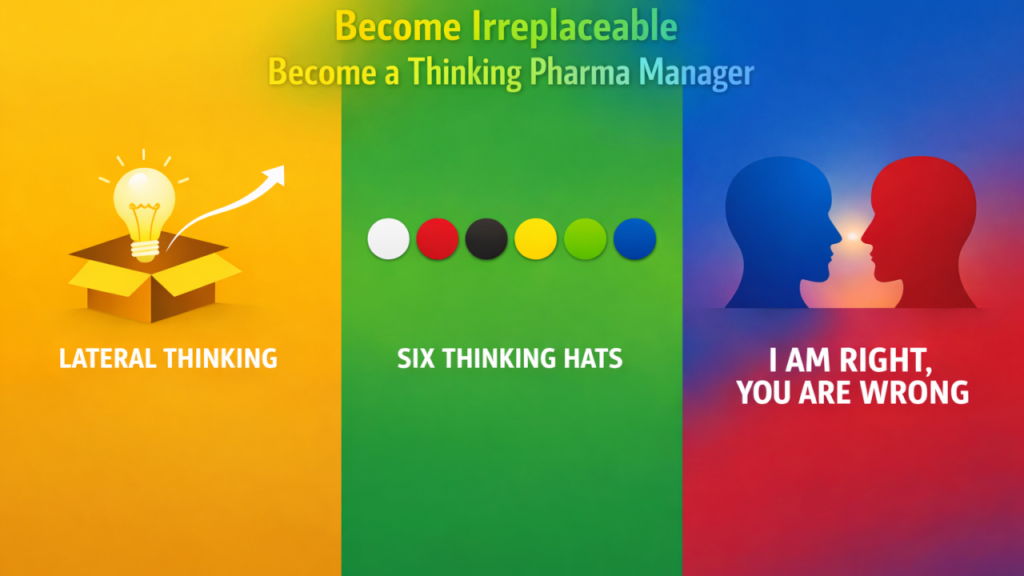
Why These Three Thinking Books Matter for Every Pharma Manager
The Indian pharmaceutical industry moves fast. Doctors change their choices, patients change their expectations, and competition shifts every few months. In such a world, technical knowledge alone cannot guarantee success. What truly strengthens a pharma manager—whether in brand, sales, marketing, medical, training, or commercial excellence—is the quality of their thinking. This is where Edward de Bono’s three books become especially valuable.
Lateral Thinking teaches managers how to break old habits of thought. Pharma teams often repeat the same tactics year after year. Lateral thinking encourages fresh angles, new possibilities, and creative solutions for brand growth, customer engagement, and patient support.
Six Thinking Hats helps teams think in a more organised way. Cross‑functional discussions often become confusing because everyone speaks from a different mindset—logic, emotion, caution, or optimism. The Six Hats method separates these modes, reduces conflict, and makes meetings faster and more productive.
I Am Right, You Are Wrong goes deeper. It explains how the mind forms perceptions, why people defend their views, and how arguments block progress. This understanding helps managers listen better, gather richer insights, and handle review meetings with maturity and calmness.
Together, these books do not give a “complete thinking toolkit”—because no toolkit is ever complete. The world keeps changing, and our thinking must keep evolving. Socrates said, “I know nothing,” reminding us that real learning begins when we accept how much we still do not know.
For pharma managers, this humility, combined with better thinking methods, creates curiosity, openness, and the ability to solve problems with clarity in a complex industry.