

H2H Mindset: Where Patient Centricity Begins – Brand Management 150
H2H Mindset: Where Patient Centricity Begins
Preamble
“If there is one industry that is closest to the concept of H2H Marketing, it is the pharmaceutical industry,” reiterated Philip Kotler during his webucational programme on 30 May 2021, held to celebrate his 90th birthday.
He went on to make a powerful observation:
“Just as the concept of the 4 Ps is valid even today, the H2H concept will live on forever.”
Why did the Father of Modern Marketing make such a powerful statement about H2H Marketing, and why did he see the pharmaceutical industry as being so closely connected to it?
The answer takes us to the very heart of what pharmaceutical marketing is, or ought to be.
Let us see how these concepts developed. Patient-Centricity came first, and H2H Marketing is the broader framework that later absorbed it.
Patient-Centricity Has Its Roots in India
Patient-centricity is not a new idea. Its roots can be traced back to India, decades before the term became a part of modern healthcare vocabulary.
I still remember those days clearly, because I was there. First as a young medical representative, and later as a District Manager with Carter‑Wallace.
I saw it with my own eyes.
In the late 1970s and early 1980s, Cipla was popularising its Asthalin inhalers for the treatment and management of asthma. But there was something remarkable about the way the product was brought to patients.
Cipla hired well qualified counsellors. They would sit in the reception areas of doctors’ clinics. When a doctor prescribed an Asthalin inhaler, the patient was guided to the counsellor, who patiently demonstrated how to use it correctly.
For mothers of young children with asthma, this simple demonstration could make an enormous difference. It transformed a prescription into understanding and understanding into confidence. A mother did not simply walk away with an inhaler; she walked away knowing how to help her child breathe better.
That small act of counselling was more than product promotion. It was empathy in action. It was education. It was empowerment. It was patient-centricity.
And perhaps, that is one reason Asthalin inhalers went on to become such a phenomenal success.
Long before patient-centricity became a strategy, Cipla was quietly putting the patient at the centre.
A quick timeline
- Patient‑centricity in pharma traces its roots back to the 1970s and 80s, during the early healthcare‑quality movement that introduced ideas like patient‑centered care and shared decision‑making, long before “H2H” became a known term.
- H2H (Human-to-Human) Marketing emerged later as a general marketing philosophy, popularized by Bryan Kramer’s 2014 book “There is no B2B.nor B2C: It’s Human to Human – H2H” A few years later, in 2021, it was formalized academically by Philip Kotler, Waldemar Pfoertsch, and Uwe Sponholz in their “H2H Marketing: The Genesis of Human-to-Human Marketing.”
- When pharma marketing thinkers applied H2H to the industry, they explicitly framed patient-centricity as pharma’s expression of the broader H2H mindset. For pharma, adapting the H2H human-centered mindset means adapting the patient-centric approach in marketing, with this move away from brand-centricity toward human and patient-centricity being described as one “brave action” within the H2H model.
In more accurate words;
Patient-centric marketing gets reinterpreted and absorbed as a pharma-specific application of H2H Marketing.
H2H is not an offshoot of patient-centricity. H2H is the general theory (applicable to any industry, B2B or B2C).
Patient-centricity is what that theory looks like when applied specifically to pharma, where the “human” in the human-to-human relationship is the patient (and often the HCP) rather than a generic customer.
H2H Marketing and Patient Centricity – Part 1
Who doesn’t love stories? From a 3-year-old kid to 95-year-old great grandfather, all do! We still enjoy listening to ‘Akbar-Birbal’, ‘Tenali Ram’, the Greek ‘Pandora’s Box or the story of the German nymph ‘Lorelei’
The book “H2H Marketing: The Genesis of Human-to-Human Marketing” is written as a story.
It is based on a German publication called Das Neue Marketing Mindset from Waldemar Pfoertsch and Uwe Sponholz.
In English, it means the ‘The New Marketing Mindset’
Like in the German publication, the principle of storytelling is also used in the English publication makes it very interesting reading.
Like in a typical Bollywood movie you have a ‘hero’, and the hero has to have the right attitude. In this book the right attitude is ‘The H2H Mindset’.
A story has some key components and here they are in this book.
Call for Adventure
First, this story starts with a “Call for Adventure”. The authors introduce the current state of marketing and ask a question to the readers: “Marketing-Quo Vadis?” “Marketing, where are you heading?”
When applied to the pharmaceutical industry, it leads to the fundamental understanding that a radical change is required in the marketing model of pharma firms. And who doesn’t know what’s happening in the pharmaceutical industry today. The layman knows. The patients know. The HCPs know.
In recent years, newer concepts and ideas have emerged in marketing, which the pharma industry should consider. One of them is building Firms of Endearment. This inspiration comes from the book of the same name by Raj Sisodia, Jagdish Sheth and David Wolfe.
What pharma needs now is a sustainable model to replace the transactional marketing model which resulted in gains just for the pharma company or the HCPs but not for whom the medicines are made – the patients.
The H2H marketing model and the evolution to the H2H marketing concept, are based on the observations and the reflections of Philip Kotler, Waldemar Pfoertsch andUwe Sponholz. And this is what pharma urgently needs now.
The H2H marketing model and the H2H marketing concept weave seamlessly into the patient-centric approach.
The authors in the initial version of, H2H marketing model called it the “Bangalore Model” because it was developed on the Christ University Campus in Bangalore.
Synonym to the acronym H2H, the authors used the term “Mensch Marketing”. It is from a Yiddish word MENTSH, MENTSH means a ‘good person’ – A person with the qualities you would hope for in a friend or trusted colleague.
Patients need HCPs and pharma companies whom they can trust as a true friend.
The authors have beautifully named the website for this book as Mensch Marketing.
H2H Marketing fulfils Philip Kotler’s dream: Marketing is to make the world a better place.
This new model has three strong pillars.
The first is Design Thinking as an innovation method for any marketing activity.
The human-centered mindset should lead to human-centered marketing. For pharma, this means adapting the patient-centric approach in marketing. Its toolbox and process-oriented approach takes marketing even further to meet current human needs.
This is also true for the second pillar, the Service-Dominant Logic (S-DL) concept.
S-DL requires you to treat products as a service offering.
A pharma product should not be viewed as just a revenue generating tool. You must view it as a tool to support a service that will benefit the end-user customer – the patient. Patients’ treatment outcome should be at the core of all activities. Or simply put, aligned very closely to the patient-centric approach. For instance, patient advocacy groups can help the caregivers at home in medicine adherence or handle side-effects.
S-DL is also human centered and delivers the basis for H2H marketing.
And the third pillar is digitalization.
In this era where homo sapiens are evolving into homo digitalis, SoLoMo mindset (Social, Local and mobile) is dominant. The third pillar of the H2H marketing model, in line with the current developments, is digitalization. Digitalization is a great opportunity for redirecting the focus of marketing to a more stakeholder-oriented concept.
The Great Journey
After the call for adventure comes the great journey.
The authors introduce a new marketing paradigm and present the H2H Marketing Model.
Interestingly, the early version of this model was called the “Bangalore Model” because it was developed on the campus of Christ University in Bangalore.
The authors also use another beautiful expression for H2H Marketing:
“Mensch Marketing.”
Mensch comes from the Yiddish word mentsh, meaning a good person, a person with the qualities we would look for in a trusted friend or colleague.
Think about that for a moment.
Patients need healthcare professionals they can trust.
They need pharmaceutical companies that behave responsibly.
They need brands that do more than make promises.
They need people who genuinely care about their journey.
That is why the name Mensch Marketing is so powerful.
The website itself carries this philosophy: Mensch Marketing.
Mensch Marketing
And perhaps this is also what Philip Kotler meant when he spoke about the larger purpose of marketing, to make the world a better place.
Three Pillars of H2H Marketing
The H2H Marketing Model rests on three powerful pillars: Design Thinking, Service-Dominant Logic and Digitalization.
1. Design Thinking – Start with the Human
Design Thinking begins with understanding people—their needs, frustrations, experiences and aspirations.
For pharma, this naturally connects with patient-centricity.
Instead of asking:
“How can we sell more of this brand?”
we should also ask:
“What problem is the patient facing, and how can we help solve it?”
This changes the way we think about everything—from product development and communication to patient support and adherence.
The patient becomes a person, not a number.
2. Service-Dominant Logic – A Medicine Is More Than a Product
The second pillar is Service-Dominant Logic (S-DL).
It encourages us to look at products not merely as physical products but as part of a larger service experience and value creation process.
This has enormous relevance for pharma.
A tablet, capsule, injection or spray should not be viewed merely as a revenue-generating product.
Its real purpose is to help improve a patient’s health and quality of life.
Imagine, for example, a patient struggling with medication adherence.
The pharma company’s responsibility need not end when the medicine reaches the pharmacy.
Patient-support programmes, educational material, caregiver support and adherence assistance can all contribute to a better treatment experience.
The medicine remains important.
But the human experience surrounding the medicine becomes equally important.
That is patient centricity in action.
3. Digitalization – Technology with a Human Purpose
The third pillar is digitalization.
We are moving from Homo sapiens towards an increasingly connected “Homo digitalis.”
Social, Local and Mobile, the SoLoMo mindset, has transformed the way people communicate, learn and make decisions.
For pharma, digitalization provides enormous opportunities.
But there is an important lesson here:
Technology should not make marketing less human. It should help us become more human.
AI, data, digital platforms and omnichannel communication can help pharma understand stakeholders better, communicate more meaningfully and provide support at the right moment.
The objective is not technology for technology’s sake.
The objective is better human connection.
H2H Marketing and Patient Centricity – Part 2
The Brave Action
Every good story eventually reaches a moment when the hero must make a difficult choice.
For pharma, that brave action is the movement:
From brand-centricity to human-centricity.
From prescription-centricity to patient-centricity.
From transactions to relationships.
From selling a product to creating meaningful value.
This is the heart of Human-to-Human Marketing.
H2H Marketing reminds us of something very simple:
All marketing is ultimately from one human being to another.
A doctor is a human being.
A medical representative is a human being.
A brand manager is a human being.
A patient is a human being.
A caregiver is a human being.
Behind every prescription, every purchase, every conversation and every decision, there is a human being.
And because humans deal with humans, trust becomes fundamental.
The foundation of the H2H Mindset is therefore:
Trust.
In a hyper-connected world, trust has become one of the most valuable currencies of business.
And in healthcare, it is perhaps even more precious.
Solutions and Return
The “solution and return” of the story is then told through the introduction of the operative marketing, which focuses on the H2H process and the necessary steps in the new forming of the marketing mix.
H2H process ties into the H2H Marketing Model.
Write the authors: “The classic 4P marketing mix has guided marketing thinking for many years. In the world of digitalization with newly restructured relationships and changed forms of communication, it may no longer be appropriate for today’s business challenges”.
Marketing measures without customer focus (patient-focus for pharma) have ceased to have a positive impact. This marketing approach challenges the core competencies needed to create and deliver meaningful value propositions to customers and other collaboration partners.
This in brief is the story which finds a meaning in the troubled world.
.
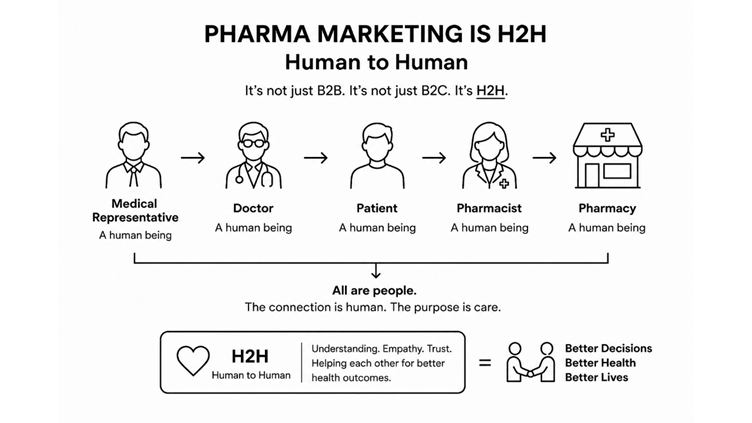
H2H marketing embraces the fact that all marketing is from one human to another. The premise, say the authors, that regardless of your business sector, or industry, at the end of the day you are talking and dealing with a human.
For pharma, the story will surely have a happy ending – because patients will be delighted at every stage of the patient journey
The Patient Journey
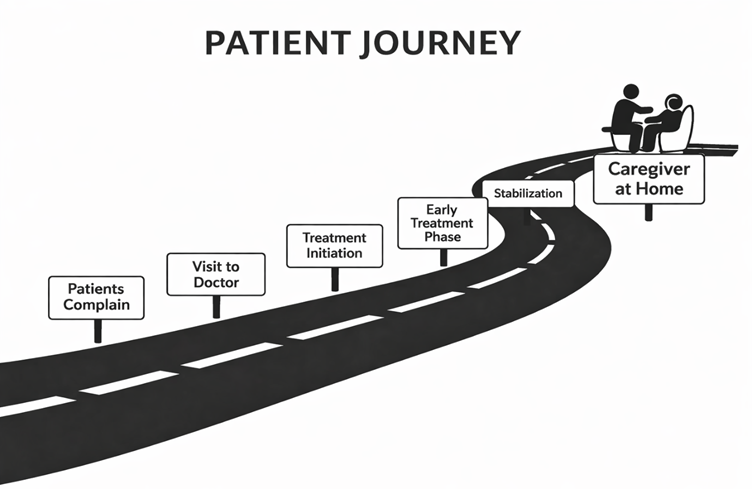
The patient journey is the complete experience a patient goes through while seeking better health, not just the visit to a doctor.
It begins with a complaint, symptom, or health concern. The patient may first speak to a family member, search for information, visit a pharmacist, or consult a doctor. The journey then continues through diagnosis, treatment, counselling, taking medicines, follow-ups, and recovery.
But the journey does not end when the patient leaves the clinic.
It continues at home, where the patient and caregiver manage medicines, follow instructions, watch for improvement, deal with difficulties, and provide emotional support.
Therefore, the patient journey is not simply a medical journey.
It is a human journey: from worry to understanding, from illness to care, and hopefully, from suffering to better health.
Three Indian examples stand out because they show that patient-centricity is not merely about giving a medicine to a patient. It is about supporting the entire care journey, doctor, patient and caregiver.
1. Cipla’s Breathefree: Helping the Patient Breathe Freely
For years, many Indian asthma patients avoided inhalers because of fear, myths and social stigma. Cipla understood that simply asking doctors to prescribe inhalers was not enough. The patient and the family at home also had to believe in the treatment.
This led to initiatives such as Breathefree and Berok Zindagi. Doctors were engaged to reinforce the science and correct use of inhalers. Patients and caregivers received education and counselling on asthma management. Families were exposed to stories and communication that helped remove the fear and stigma around inhalers.
The approach went beyond the prescription.
Cipla reported that, in 2020–21, more than 5,500 doctors and 600 Breathefree Educators counselled around 700,000 patients. Its digital educator also helped patients learn the correct way to use inhalers.
The lesson: The doctor prescribed. The patient understood. The family supported. Cipla tried to connect all three.
2. Sanofi’s Saath7: Staying with the Diabetes Patient
Diabetes does not end when the doctor writes a prescription. The real battle begins at home, taking medicines correctly, following a diet, making lifestyle changes and staying committed for years.
Sanofi India’s Saath7 recognised this reality. Through the programme, doctors could refer patients to professionally trained counsellors. These counsellors provided education, regular counselling and follow-up through in-person visits, telephone calls and digital tools. The programme therefore supported both the doctor and the patient, while giving the patient practical help that could continue at home.
What is Saath7?
Saath7 is Sanofi’s unique patient support program (PSP) that helps lakhs of people living with diabetes, manage their condition better. Our stellar team of professionally trained counsellors from across 45 cities caters to the educational and counselling needs of patients enrolled in our program, by over 5000 doctors from across the country.
Saath7:
- Educates, empowers and handholds people living with diabetes to improve treatment outcomes
- Supports doctors (with very high patient loads and a paucity of time) in educating patients
- Operates through a hybrid model via regular in-person visits, daily telephonic counselling and through our virtual PSP toolkits that empower over 100,000 patients every year to manage diabetes in a better manner
3. Lupin’s Hum Rahi – “A Companion in the Diabetes Journey”
Lupin’s Hum Rahi is perhaps the strongest example to use. The name itself means “companion.” Launched in 2023, the programme was designed to support people with diabetes beyond the doctor’s prescription. It provides personalised diet counselling, medication assistance, lifestyle guidance, insulin-injection education and treatment-adherence support, with healthcare professionals involved in the care process.
What makes the story interesting is that diabetes is largely managed at home. The doctor can prescribe the right treatment, but every day the patient and family have to make decisions about food, medicines, exercise, blood-sugar monitoring and insulin administration.
Hum Rahi therefore becomes a bridge between the doctor’s advice and the patient’s everyday life. Its multilingual support, educators, counselling, monitoring tools, camps and health services help patients continue their journey after leaving the doctor’s clinic. Lupin says the programme supported more than 100,000 patients in FY25 and included 200+ diabetes educators.
There is an even earlier Lupin story. Its HUMRAHI Patient Support Program for insulin-treated patients engaged more than 4,000 healthcare professionals and reached over 150,000 patients across 20 Indian cities. It included diet counselling, insulin-pen education, insulin-storage advice and guidance on exercise.
The beautiful lesson!
What makes the approach powerful: the doctor does not stand alone, the patient does not struggle alone, and the caregiver at home is not left alone.
These examples show the real meaning of patient-centricity:
Do not stop at the prescription. Walk with the patient and the family through the journey.
The doctor starts the treatment. The patient lives the treatment. The caregiver helps sustain the treatment. Patient-centric pharma must therefore support all three.
That fits beautifully into the larger H2H Marketing and Patient-Journey narrative.