
The Next Pharma Frontier Isn’t Another Country. It’s India! Brand Management 157
Lead Author – Shailaja Dwivedi Pathak, with Vivek Hattangadi
For Pharma India, some of our most important emerging markets are not emerging countries. They are the emerging markets within India; Tier 3, Tier 4, small towns and rural India.”
“Can we build the future of pharma sales in rural India using the same model that we use in Mumbai, Delhi or Bengaluru?”
The answer is: Absolutely No.
The problem in rural and small-town India is not simply that there are fewer doctors.
It is that the entire healthcare ecosystem is different.
There may be:
- Fewer specialists
- Smaller doctor populations
- Long distances between customers
- Fragmented retail distribution
- Smaller order sizes
- Connectivity challenges in some locations
- Language and cultural differences
- Greater dependence on local relationships
- Limited access to diagnostic facilities
The Ministry of Health identifies shortage of doctors and specialists, inadequate capacity and difficulties in prescription and drug dispensing as important challenges in rural healthcare and specifically recognises information technology as an enabler to address some of these barriers.
So, the question is not;
“How do we take the urban pharma model to rural India?”
The real question is:
How do we redesign the pharma model for rural India, and use technology to make it economically viable?
What is the big idea? Technology should solve the “last mile” problem
Think of the concept of the Last-Mile Medical Representative.
The traditional model says:
Company → CFA → Stockist → Retailer → Patient
And on the demand side:
Company → MR → Doctor → Prescription → Patient
But in Tier-3, Tier-4 and rural India, the last mile can become expensive and inefficient.
Technology can help create a phygital model:
Human relationship + Digital intelligence
The Medical Representative does what humans do best:
Build trust. Explain. Listen. Influence.
Technology does what technology does best:
Map. Analyse. Predict. Connect. Remind. Track.
That is a very powerful combination.
Example 1: GoApptiv, technology-enabled rural reach
A particularly relevant Indian example is GoApptiv.
GoApptiv is an Indian healthcare access platform that connects healthcare professionals, healthcare companies, patients, and channel partners through a “phygital” model, meaning it combines digital tools with on-ground support. In simple terms, it helps improve access to healthcare and medicines, especially in extra-urban and rural areas of India.
It is helps pharma and healthcare companies reach more markets, support better patient experience, and build the digital infrastructure needed for wider healthcare access.
Its focus is improving access to primary healthcare and quality medicines across India.
It supports a network spanning 697 districts and more than 4.7 lakh villages, with 78,000+ retailers and about 23,000 stockists/sub-stockists.
Its technology connects healthcare companies with channel partners and retail chemists, providing visibility into sales and enabling data-driven decisions.
This is interesting for your presentation because it demonstrates that technology does not have to mean an expensive AI platform.
Sometimes technology’s greatest contribution is simply:
“I know where the medicine is. I know where it is needed. I know who has it. And I can move it there.”
That is sales intelligence meeting healthcare access.
And there is a beautiful phrase from their model that you could use:
“Phygital for the last mile.”
Not digital replacing people.
Digital making people more effective.
Example 2: eSanjeevani — technology overcoming geography
eSanjeevani is India’s government-run telemedicine service. It lets people consult doctors remotely, often from home or through health and wellness centres, so they can get medical advice without traveling far.
It has two main uses: doctor-to-doctor consultations for health centres, and doctor-to-patient online OPD consultations for citizens.
It is a digital bridge that helps people, especially in rural and remote areas, access healthcare more easily.
India’s eSanjeevani is perhaps one of the strongest examples of technology overcoming the geographical barriers of rural India.
This gives you a very important insight for pharma:
“If technology can take a specialist consultation to a village, why can’t technology take better scientific information, better sales intelligence and better healthcare support to the same village?”
That is a powerful bridge from digital healthcare to digital pharma sales.
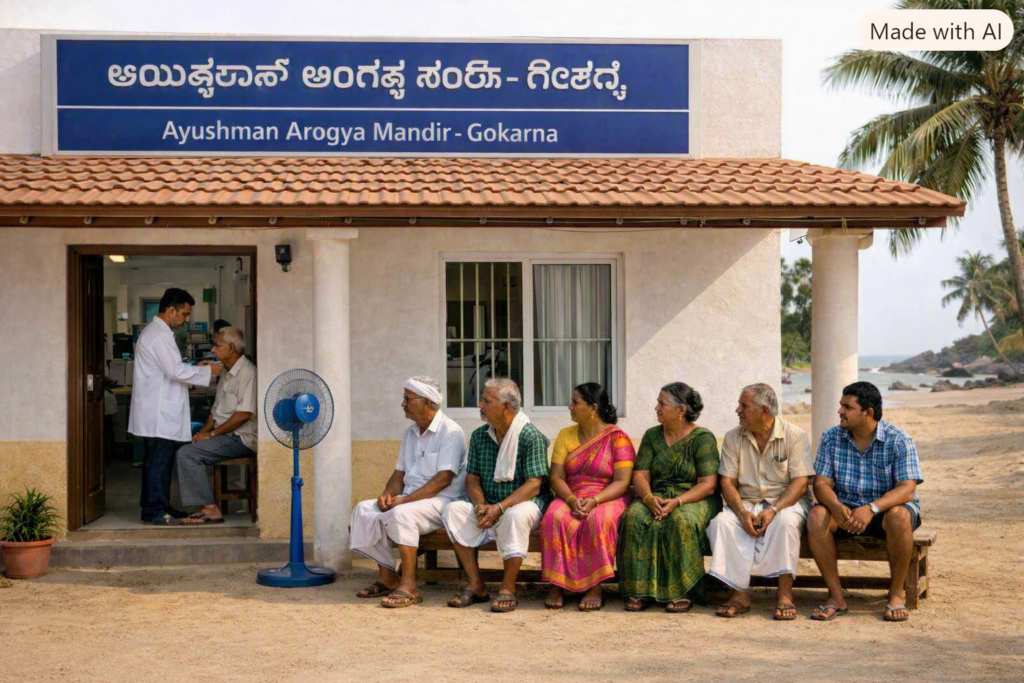
Important to note! This is not a theoretical possibility. The Ayushman Arogya Mandir network currently reports nearly 1.87 lakh functional centres, with teleconsultation and drug-distribution services built into the model.
“Technology may give us reach. But local people give us trust.”
Now bring AI into the story
Imagine a pharma company covering 10,000 villages.
You don’t necessarily want a Medical Representative visiting every village.
AI could classify villages into:
A — High potential
Physical sales-force presence
B — Medium potential
Hybrid MR + digital engagement
C — Low potential
Digital + distributor-led coverage
And the algorithm could continuously look at:
Population + disease burden + doctor availability + pharmacy density + prescription potential + sales + competitor presence + stock availability + geography.
Now the company can ask:
“Where should my next Medical Representative go?”
That is a completely different way of looking at rural sales-force deployment.
Technology can make the small market viable
But don’t make one mistake: Rural India cannot be conquered through an app.
It cannot. Rural India is a relationship market.
A digital message may reach a doctor.
But trust is built by a human being.
A chatbot can answer.
But a local Medical Representative can understand the doctor’s real concern.
An algorithm can identify a village.
But a person understands its people.
So, your philosophy can be:
AI for intelligence.
Technology for reach.
People for relationships.
That is H2H philosophy meeting technology.
THE RURAL PHARMA MODEL OF THE FUTURE
AI
↓
Find the opportunity
Technology
↓
Connect the ecosystem
Distribution
↓
Make the medicine available
Medical Representative
↓
Build the relationship
Doctor
↓
Make the clinical decision
Patient
↓
Receives better access
“The objective of technology in rural India is not to remove the human being. It is to remove the barriers that prevent the human being from reaching the patient.”
And the final message!
The future of Indian pharma sales may not be found only in the largest cities. It may be found in the smallest towns and the remotest villages, if we can combine the intelligence of technology with the humanity of the people who serve them.