
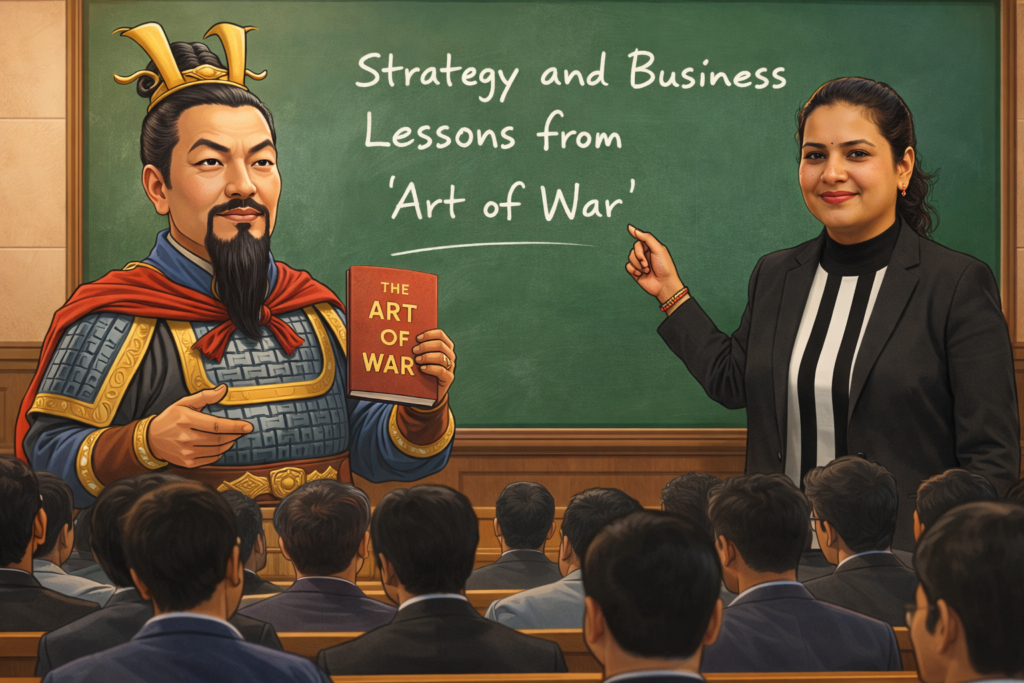
Strategy and 9 Business Lessons from ‘Art of War’: A Strategic Mind Sharpener for Every Brand Builder – Brand Management 134
Author – Shailaja Dwivedi Pathak
Each lesson comes alive through a real case study, making the ideas practical, memorable, and immediately usable.
And every principle also connects at a personal level, helping readers think more clearly, act with intent, and lead with calm strength.
If you want to sharpen your strategic mind, elevate your brand thinking, and grow as a leader, this essay will shift something inside you.
Sun Tzu’s Principle 1: Know your enemy
This fits beautifully in pharma.
Half the battle is won when you clearly understand what you’re fighting against.
In business, the “enemy” is competition.
In daily work, it can also be our own habits, delays, or fears.
In the pharma industry, “knowing your enemy” means deeply understanding both your competitors and the barriers inside your own company.
A good example is Dr. Reddy’s vs. Teva in the U.S. generic market. When Dr. Reddy’s planned to launch a generic version of a major Teva drug, they didn’t just study the molecule.
They studied Teva’s pricing, supply chain strengths, past patent strategies, and even how fast Teva usually reacts to new competition.
This awareness helped Dr. Reddy’s choose the right launch timing and price, and they captured strong early market share.
Inside India, many brand managers face another “enemy”: their own assumptions. For example, a team may believe a doctor segment is loyal to a competitor, but field insights may show that doctors are actually unhappy with stock-outs or poor patient support. When managers recognise this “internal blind spot,” they can act faster and win.
Sun Tzu Principle 2: Know Yourself
No growth begins without honesty.
Strength is useless if you don’t know your limits.
In pharma, “knowing yourself” means being honest about your real strengths, weaknesses, and blind spots.
Many companies focus only on what competitors are doing, but Sun Tzu reminds us that the bigger battle is inside.
A good example is Cipla’s respiratory leadership.
In the late 1970s, Cipla realised something important: they were strong in inhalation technology but weak in-patient education and device training.
Instead of ignoring this gap, they accepted it. They invested in counsellors for patients at the doctors’ clinics, to demonstrate how to use inhalers, now an easy‑to‑use device.
This honest self‑assessment helped them grow into one of the strongest respiratory players in India and abroad.
For individuals too, this principle matters.
A brand manager who knows they struggle with data analysis can seek help early, build the skill, and avoid costly mistakes.
Honesty becomes a growth engine.
Sun Tzu Principle 3: Deception
The point is not to lie.
The point is to avoid predictability.
Because once you’re predictable, you’re defeated.
In pharma, “deception” simply means don’t let competitors read your next move.
You don’t cheat. You don’t mislead doctors or patients. You only avoid becoming predictable.
A strong example is Novo Nordisk during the rise of GLP‑1 drugs.
While competitors expected them to focus only on diabetes, Novo built a huge pipeline for obesity, patient‑support programs, and long‑term supply planning.
They used a different brand name Wegovy.
By the time others understood the shift, Novo was already years ahead. They didn’t lie. They just didn’t announce their strategy too early.
In India, many companies lose advantage because their brand plans look the same every year. Same CME, same messages, same tactics. Competitors can guess every move.
Sun Tzu reminds us: surprise is a strategy. Predictability is defeat.
Sun Tzu Principle 4: Adaptation
The rigid tree breaks in the storm.
The reed bends and survives.
In pharma, adaptation is not optional. Markets shift, guidelines change, and competitors move fast. The companies that stay rigid lose ground.
The ones that bend, learn, and adjust survive and grow.
A strong example is Lupin in the U.S. market.
When their generic pipeline faced delays and price pressure, they didn’t stay stuck. They adapted by investing in complex generics, inhalation products, and specialty drugs.
This shift helped them stay relevant even when the old model stopped working.
On the field too, medical reps who adapt win more.
A rep who notices that doctors now prefer short digital updates instead of long face‑to‑face calls must change their style. The message stays the same, but the method evolves.
Sun Tzu’s lesson is simple: flexibility is strength. Adaptation keeps you alive in the storm.
Sun Tzu Principle 5: Timing
Patience creates power. The right move too early or too late is still failure.
In pharma, timing is often the difference between a strong launch and a wasted opportunity.
A great strategy can fail if the market is not ready. A good product can struggle if it enters too late.
A powerful example is Biocon’s entry into biosimilars.
They didn’t rush in when the space was still unclear. They waited, built capability, partnered with Mylan, and entered global markets when regulations, demand, and pricing were aligned. Their timing helped them become one of the world’s leading biosimilar players.
On the field too, timing matters.
A rep who pushes a new message before a doctor sees enough patients in that segment will fail. But the same message, delivered when the doctor is facing real patient challenges, creates impact.
Sun Tzu’s reminder is simple: power comes from choosing the right moment.
Sun Tzu Principle 6: Use Strength Against Weakness
Don’t fight where the opponent is ready. Shift the game to where you hold the cards.
In pharma, this principle is powerful. Many companies waste time attacking a competitor’s strongest area, their biggest brand, their deepest doctor loyalty, or their strongest specialty.
Sun Tzu says: don’t fight there. Instead, find the space where you are stronger and the competitor is not prepared.
A good example is Torrent Pharma in cardiology. Instead of trying to beat giants like Sun Pharma or USV in their strongest molecules, Torrent focused on fixed‑dose combinations, patient‑friendly packs, and strong KOL relationships in Tier‑2 and Tier‑3 cities.
They shifted the battlefield.
Competitors were busy fighting in metros; Torrent quietly built dominance elsewhere.
On the field too, a rep should not push a message where a competitor is already deeply entrenched. Instead, highlight your brand’s unique strength better safety, easier dosing, or stronger patient support.
Sun Tzu’s lesson: win where you have the edge, not where others expect you.
Sun Tzu Principle 7: Win Without Fighting
The highest mastery is victory without destruction.
In business, by shaping markets.
In life, by dissolving conflicts before they erupt.
In pharma, “winning without fighting” means creating value so strong that competition becomes irrelevant. Instead of battling for prescriptions, you shape the market in a way that naturally pulls doctors, patients, and partners toward you.
A powerful example is GSK with vaccines.
They didn’t fight brand‑to‑brand battles.
They built awareness programs, trained paediatricians, supported government immunisation drives, and shaped public understanding of disease prevention.
By the time competitors entered, GSK had already shaped the market mindset. They won without a fight.
On the field too, a rep can “win” by solving a doctor’s real problem, patient adherence, device technique, or stock issues, instead of arguing about superiority.
When trust is built, resistance disappears.
Sun Tzu’s wisdom is simple: the smartest victory is the one that doesn’t need a battle.
Sun Tzu Principle 8 — Momentum
Small advantages, used well, become big victories.
Momentum turns effort into effortless progress.
In pharma, momentum is one of the most underrated forces.
A brand that starts well, even with a small base, can grow rapidly if the team keeps the energy, consistency, and focus alive. But if momentum is lost, even a strong brand can slow down.
A clear example is Ajanta Pharma in ophthalmology. They didn’t begin as the biggest player. But once their early brands gained acceptance, they built on that momentum with fast launches, strong doctor engagement, and reliable supply. Each small win created the next win. Over time, they became one of the most respected players in the segment.
For individuals too, momentum matters.
A rep who has a good month should not relax. They should build on it — more calls, better planning, sharper follow‑ups. Small wins create big confidence.
Sun Tzu’s message: once the wheel starts turning, keep it turning.
Sun Tzu Principle 9: Shape Perception
People don’t respond to reality.
They respond to how they see reality.
Control perception, and you control the outcome.
In pharma, perception is often more powerful than features. A brand may have strong data, but if doctors feel it is complicated, risky, or outdated, the brand will struggle.
Sun Tzu teaches us that shaping perception is not manipulation. it is clarity, consistency, and storytelling.
A strong example is Abbott with Thyronorm in India.
The molecule is old, yet Abbott shaped the perception of reliability, by having every SKU to suit the patient because hypothyroidism needs precise dosing.
Doctors began to see it as the “safe default.” GSK once owned the market with Eltroxin. But Abbott shaped the perception and eventually overtook Eltroxin.
Today, Thyronorm owns both the perception space and the market.
On the field too, a rep who appears prepared, calm, and respectful shapes how the doctor sees the brand. Confidence builds trust. Trust shapes decisions.
Sun Tzu’s message: win the mind, and the market follows.
Conclusion
After learning the nine Sun Tzu principles, brand managers should turn insight into action.
First, they must study their market, competitors, and their own brand with honesty. Then they should plan smarter, choosing battles where they have strength, avoiding predictable tactics, and adapting quickly when the market shifts.
They must shape doctor perception with clear, consistent messaging and build momentum through small, steady wins.
Most importantly, they should aim to “win without fighting” by solving real doctor and patient problems. When these principles become habits, brand managers grow faster and build stronger, more resilient brands.
Sun Tzu was not teaching us how to destroy.
He was teaching us how to endure.
How to win in a world that will never stop evaluating us.
Author – Shailaja Dwivedi Pathak