
Before You Lead Others, Lead Yourself – Sales Management 30
It was 10:45 p.m. when Vikram Verma, yhe District Manager, (First‑line Manager) at Canopus Biotherapeutics, finally reached home.
The day had been long nine joint calls, chemist visits, one tense review with a medical representative who had missed his target again. He dropped his bag on the sofa, loosened his tie, and poured himself a glass of water. The house was silent. But inside him, a storm was brewing.
He had joined Canopus eight years ago, as a medical representative full of energy and ambition. Five years later, he was promoted as District Manager.
He wanted to be the kind of leader who inspired his team, who built brands with purpose, who made his Sales Director proud.
Yet lately, he felt stuck, not because the market was tough, but because he was.
He was doing everything right on paper: planning, reporting, reviewing. But something was missing, something invisible, something human.
That night, he remembered a line from Ram Prabhu, his Sales Director, spoken during a leadership workshop in Lonavala:
“Vikram, the hardest mirror to look into is the one that shows your own leadership.”
Ram Prabhu was known across Canopus for his calm authority. He never raised his voice, yet his words carried weight. He believed that leadership wasn’t about control — it was about clarity.
And clarity, he said, came only through self‑reflection.
The Conversation That Changed Everything
A week earlier, Vikram had sat across from Ram Prabhu in the company cafeteria.
Ram had noticed the fatigue in his eyes.
“Vikram,” he said gently, “you look tired. Not field‑tired — thought‑tired.”
Vikram smiled weakly. “I guess I’m just trying to keep everything running.”
Ram leaned forward. “Running is good. But tell me, are you growing?”
The question hit like a dart. Vikram had no answer.
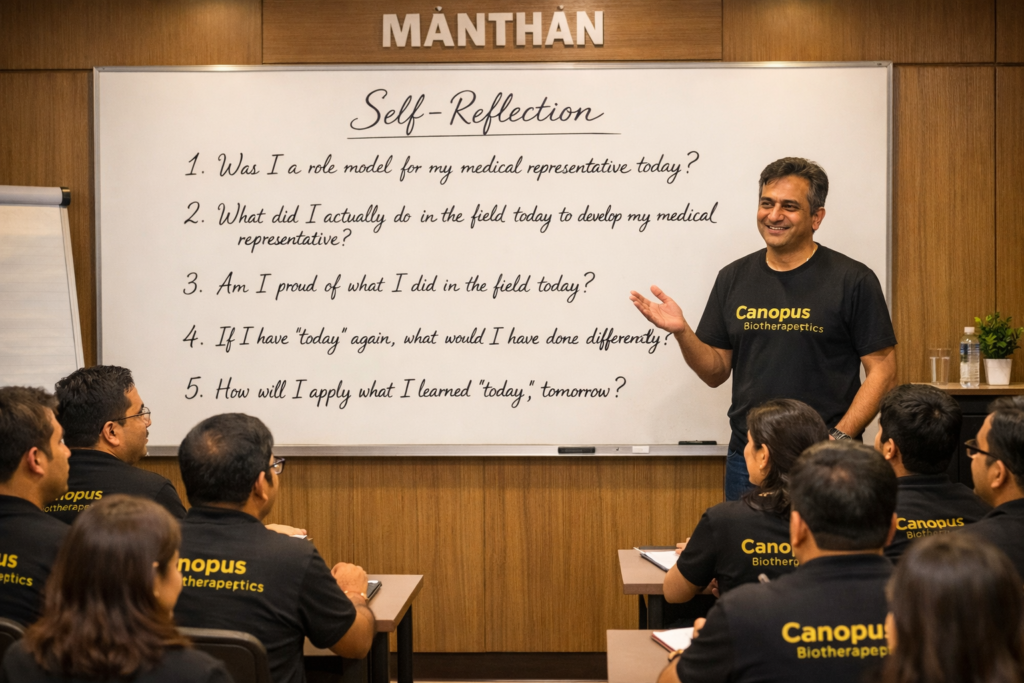
Ram continued, “You know, when I was a first‑line manager, I used to ask myself five questions every night before sleeping. They kept me honest.”
He wrote them down on a napkin:
- Was I a role model for my medical representative today?
- What did I actually do in the field today to develop my medical representative?
- Am I proud of what I did in the field today?
- If I have ‘today’ again, what would I have done differently?
- How will I apply what I learned ‘today’, ‘tomorrow’?
Ram folded the napkin and handed it to him. “Try this for a week,” he said. “You’ll be surprised what the mirror shows.”
The First Night
So that night, Vikram sat at his desk, opened his diary, and wrote the first question:
Was I a role model for my medical representative today?
He thought of the morning call with Ramesh, his rep in Surat.
He had scolded him for missing the secondary sales target.
But had he shown him how to win?
Had he inspired him to try again?
He realized he hadn’t.
He had managed the numbers, not the person.
He wrote slowly:
“I was a manager today, not a leader.”
The second question followed:
What did I actually do in the field today to develop my medical representative?
He remembered how he had rushed through the calls, focusing on coverage rather than coaching.
He had corrected Ramesh’s detailing but never asked what Ramesh felt about the doctor’s response. He had taught technique, not thinking.
He wrote: “I corrected him, but I didn’t connect with him.”
The third question:
Am I proud of what I did in the field today?
He paused.
He wasn’t.
He felt efficient, but not effective.
The fourth:
If I have ‘today’ again, what would I have done differently?
He smiled faintly.
“I would listen more,” he wrote. “And speak less.”
The fifth:
How will I apply what I learned ‘today’, ‘tomorrow’?
He wrote:
“Tomorrow, I’ll start the day by asking Ramesh what he learned yesterday — not what he sold.”
He closed the diary.
For the first time in months, he felt lighter.
The Ripple Effect
Over the next few weeks, Vikram made self‑reflection a ritual.
Every evening, he spent ten minutes with his diary; no phone, no noise, just honesty.
He began noticing patterns: how his tone affected morale, how his impatience killed initiative, how his silence sometimes spoke louder than his words.
He started changing small things.
He began his field days with a question instead of an instruction.
He praised effort, not just results.
He asked his team what they thought before telling them what he thought.
Slowly, the team’s energy shifted.
Ramesh started taking ownership of his calls.
Another rep, Meena, began suggesting creative ideas for doctor engagement.
The team meetings became conversations, not monologues.
Ram Prabhu noticed the change.
During a monthly review, he said, “Vikram, your team looks alive again.”
Vikram smiled. “I guess I started looking in the mirror.”
Ram nodded. “That’s where leadership begins.”
The Lesson Beyond Numbers
Months passed. Canopus Biotherapeutics launched a new biologic therapy, a complex product requiring deep scientific understanding and emotional selling.
Vikram’s team was chosen for the pilot rollout.
They didn’t just meet their targets; they exceeded them.
But more importantly, they built trust with doctors who had never prescribed biologics before.
When Ram Prabhu visited the region, he asked one of the doctors, “What made you start prescribing Canopus’s product?”
The doctor replied, “Your team doesn’t sell. They educate. They listen.”
Ram smiled.
That was the power of reflection — it had turned a team of sellers into a team of learners.
The Mirror Never Lies
One evening, after a successful quarter, Vikram sat again at his desk.
He opened his diary and read his first entry from months ago:
“I was a manager today, not a leader.”
He smiled. He had come a long way.
He realized that self‑reflection wasn’t about guilt or perfection. It was about awareness; the courage to see yourself as you are, and the humility to become better.
He wrote his final note for the day:
“Leadership begins when you stop blaming the mirror and start cleaning the reflection.”
Epilogue: Ram Prabhu’s Words
At the annual leadership meet, Ram Prabhu addressed all first‑line managers.
He spoke softly, but every word carried weight.
“In pharma, we measure everything — calls, coverage, conversions.
But the one thing we rarely measure is ourselves.
Self‑reflection is not a luxury; it’s a discipline.
It’s what separates a manager from a mentor.”
He paused, looking around the room.
“Every evening, before you sleep, ask yourself those five questions.
They will not just make you better leaders — they will make you better human beings.”
Vikram sat in the front row, listening.
He felt a quiet pride, not the pride of achievement, but the pride of awareness.
He knew now that leadership wasn’t about being perfect.
It was about being present. with your team, with your purpose, and with yourself.
Final Thought
Self‑reflection is uncomfortable at first.
It forces you to confront your blind spots, your habits, your ego.
But once you start, it becomes addictive — because you begin to see progress not just in your numbers, but in your character.
And that’s what Vikram Verma discovered at Canopus Biotherapeutics:
The mirror doesn’t judge.
It simply shows you the truth.
And when you dare to look at it every night, you don’t just become a better First‑line Leader: you become a better version of yourself.