WHEN PHARMA PUTS PEOPLE FIRST: Novo’s Rebrand, the H2H Mindset and the New Face of Patient-Centred Marketing – Brand Management 159
A Harvard-Style Case for Students of Pharmaceutical Brand Management
Case date: September 2026
Preamble
My daughter Shailaja was excited. She had started her career in Novo Nordisk, and there was a huge smile on her face too!
She pointed me to a press release dated 14 September 2026. She pointed me to a press release dated 14 September 2026.
She almost yelled, “बाबा, बाबा, this is an excellent story. It can easily be turned into a case study for students of pharma brand management in India. See how beautifully this press statement aligns with Philip Kotler’s H2H mindset.
It shows how this rebranding reflects the way a modern pharmaceutical company should think about people, patients, brands, and culture.”
Based on this is the Harvard-style Case Study
No more Nordisk as Novo goes it alone amid rebranding push
As Novo Nordisk continues its epic battle with Eli Lilly for market share in the increasingly competitive obesity and diabetes space, Novo is launching a major rebrand of its business, logo and name.
Much like GSK (formerly GlaxoSmithKline) and the once Sanofi-Aventis (now just Sanofi), Novo Nordisk is slimming down its brand. While Novo Nordisk A/S remains the legal global company name, “Novo” will become.
On 14 September 2026, Novo Nordisk announced a significant change in how it would present itself to the world.
The company would increasingly use the single name “Novo” in its day-to-day identity, while retaining Novo Nordisk A/S as its legal corporate name. At the centre of the new brand was a simple proposition:
“Lasting Health Starts Now.”
At the same time, Novo introduced a new set of cultural principles called “The Novo Way.”
The company described the change not merely as a visual rebranding exercise, but as part of its next chapter, intended to bring better health to more people with greater focus, speed and impact. (Novo Nordisk)
For students of pharmaceutical brand management, however, a bigger question emerged:
Was this simply a corporate rebranding exercise, or was Novo signalling a deeper change in the way a pharmaceutical company thinks about people and healthcare?
1. THE PHARMA MARKETER’S DILEMMA
For decades, pharmaceutical marketing has often been organised around products, brands, molecules, indications, prescribers and market shares.
The traditional mental picture can be quite straightforward:
Disease → Doctor → Prescription → Target→ Review
But healthcare is changing.
Patients have greater access to information. They increasingly participate in decisions concerning their health. Their expectations extend beyond the efficacy of a medicine. They also care about convenience, experience, support, trust, affordability, accessibility and how treatment fits into everyday life.
Novo itself acknowledged this changing environment, stating that healthcare needs to become more responsive, relevant and easier to fit into everyday life. (Novo Nordisk)
This creates an important question for pharmaceutical marketers:
If healthcare is ultimately about human beings, should pharmaceutical marketing also become more human?
This is where the case becomes particularly interesting.
2. ENTER THE H2H MINDSET
Philip Kotler, together with Waldemar Pfoertsch and Uwe Sponholz, introduced the Human-to-Human (H2H) Marketing approach.
H2H Marketing argues for a more human-centric approach to marketing and brings together ideas such as Design Thinking, Service-Dominant Logic and digitalisation. It shifts attention from treating customers as abstract market segments toward understanding people and creating meaningful value for stakeholders. (Springer)
The important distinction for pharma students is this:
B2B
Company → Doctor/Hospital
B2C
Company → Consumer
H2H
Human → Human
In healthcare, this does not mean abandoning scientific rigour or regulatory discipline.
It means asking a different question:
Behind every prescription, every patient, every doctor and every healthcare professional is a human being. Have we designed our marketing around the human being or around the transaction?
This makes the Novo case particularly relevant.
3. WHAT EXACTLY HAS NOVO CHANGED?
Novo’s rebrand has several interconnected elements.
The new central idea
“Lasting Health Starts Now.”
Novo explains this through the belief that lasting health begins today rather than someday, with progress that people can see and feel day by day.
The corporate name
Novo will be the company’s day-to-day name, while Novo Nordisk A/S remains the legal company name.
The visual identity
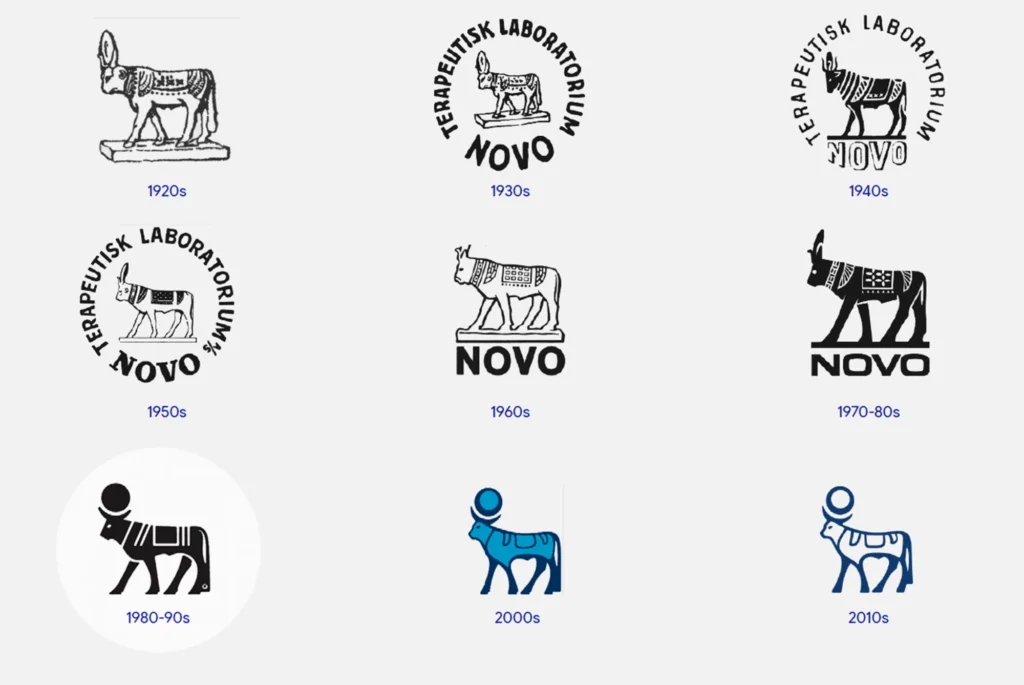
The familiar Apis bull, which has been part of the company’s brand since the 1920s, has been updated to give it a contemporary expression while retaining its heritage.
The cultural change
Novo simultaneously introduced “The Novo Way.”
This is important.
The company explicitly says that brand and culture work together: culture shapes how the company works, while the brand shapes the value people attach to its products and services and how the company is perceived.
This raises a fundamental brand-management question:
Can a brand promise be credible if the culture inside the organisation does not live that promise?
4. THE NOVO WAY
The new culture is built around four principles.
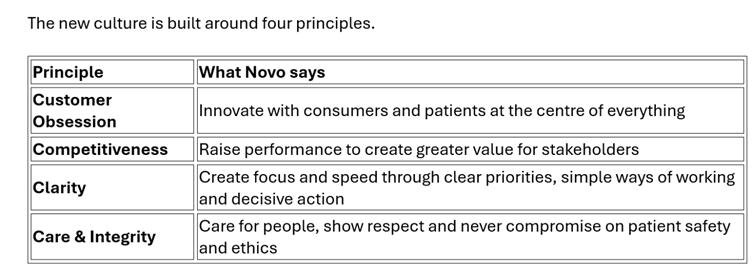
These principles are explicitly connected to the company’s history of breakthrough science, expertise, care for people and commitment to patient safety.
Now consider the four principles from the perspective of a pharmaceutical brand manager.
Customer Obsession asks:
Do we really understand the patient beyond the disease?
Competitiveness asks:
Can human-centric marketing also create business value?
Clarity asks:
Can a simple brand idea be more powerful than a complicated communication platform?
Care & Integrity asks:
Can a pharmaceutical brand build trust without compromising ethics and patient safety?
Suddenly, the corporate rebrand becomes a marketing-management case.
5. FROM PATIENT-CENTRICITY TO HUMAN-CENTRICITY
Pharma companies have spoken about patient-centricity for many years.
But patient-centricity can mean different things.
Sometimes it means:
- patient education;
- patient support programmes;
- adherence initiatives;
- disease-awareness campaigns;
- patient assistance;
- convenience programmes.
These are valuable.
But H2H thinking potentially takes the question one step further.
Instead of asking:
“How can we market our medicine to the patient?”
the organisation asks:
“How can we understand the human experience of living with this condition and create meaningful value around it?”
That distinction is crucial.
Novo’s own current description of its approach says that it begins with health as people experience it and recognises that health is connected to people’s bodies, minds, routines, relationships, communities and cultures. (Novo Nordisk)
Its current description of what it does similarly says that its approach starts with people and seeks to understand the biological, emotional, social, cultural and environmental factors that shape health. (Novo Nordisk)
For a pharmaceutical brand manager, this changes the starting point of strategy.
6. A DIFFERENT BRAND-BUILDING EQUATION
Traditional pharma brand thinking might begin with:
Molecule → Mechanism → Evidence → Differentiation → Communication
A human-centric approach could begin with:
Human need → Human experience → Unmet need → Value creation → Scientific solution → Brand experience
The science does not disappear.
The starting point changes.
This is perhaps the most important lesson students should debate.
The pharmaceutical product remains critically important. Clinical evidence remains non-negotiable. Safety remains non-negotiable.
But the product becomes part of a larger human story.
7. THE SIGNIFICANCE OF “LASTING HEALTH STARTS NOW”
Consider the wording carefully.
Novo did not choose:
“The World’s Best Science.”
Nor:
“Leading Innovation in Healthcare.”
Nor:
“Better Medicines for Better Health.”
Instead:
“Lasting Health Starts Now.”
The proposition contains three important ideas.
LASTING
It points toward the future.
Health is not presented as a one-time transaction.
HEALTH
The focus moves beyond a particular medicine or molecule.
The object of attention is the person’s health.
STARTS NOW
The future is connected to an action in the present.
The idea is immediate rather than distant.
Novo describes the proposition as being based on progress people can see and feel day by day. (Novo Nordisk)
For students, the challenge is to determine whether this creates a meaningful brand promise and, if so, how that promise could influence marketing behaviour.
8. THE REAL CASE QUESTION
Imagine you are sitting in the office of a Novo brand leader in India.
You have been asked:
“We have a new corporate brand. We have a new promise. We have a new culture. What does this actually mean for the way we build and manage pharmaceutical brands?”
You cannot simply change the logo on your visual aid.
You cannot simply change the opening slide of your doctor presentation.
You cannot simply put “Lasting Health Starts Now” on an advertisement.
The deeper question is:
How does a human-centric corporate philosophy translate into everyday pharmaceutical brand management?
9. THE PHARMA INDIA QUESTION
Now bring the case into the Indian pharmaceutical context.
Consider a hypothetical chronic-disease patient in India.
She may be:
- living with a chronic condition;
- working;
- managing a family;
- worried about treatment costs;
- concerned about side effects;
- struggling with adherence;
- searching for information online;
- consulting more than one healthcare professional;
- influenced by family members;
- trying to fit treatment into a busy daily routine.
The physician is equally human.
The medical representative is human.
The pharmacist is human.
The caregiver is human.
The brand manager is human.
The patient is human.
So why should pharmaceutical marketing behave as though it is only a transaction between a company and a prescription writer?
This is the heart of the H2H challenge.
10. THE STUDENT ASSIGNMENT
You are the Brand Management Team for Novo India.
Your task is not to redesign the Novo logo.
Your task is to determine:
How should the H2H mindset influence pharmaceutical brand management in India?
Prepare a recommendation covering the following five areas.
A. Brand Strategy
How should “Lasting Health Starts Now” influence the way a pharma brand defines its:
- target;
- insight;
- unmet need;
- value proposition;
- positioning;
- brand promise?
B. Patient-Centred Marketing
How can patient-centricity move beyond patient education and support programmes?
What would a genuinely human-centric brand experience look like?
C. Doctor Engagement
If the patient is at the centre, what changes in the way the brand engages physicians?
Does the doctor become merely a prescriber, or an important partner in creating better patient outcomes?
D. Brand Experience
What should the patient experience at every relevant touchpoint?
Think beyond advertising.
Consider:
Doctor → Medical Representative → Pharmacy → Digital → Patient Support → Follow-up → Treatment Experience
E. Internal Culture
How should The Novo Way influence the behaviour of:
- brand managers;
- sales managers;
- medical representatives;
- medical teams;
- digital teams;
- customer-facing teams?
11. THE BIGGER QUESTION: CAN BRAND AND CULTURE REALLY BE SEPARATED?
Novo makes a strong statement:
Brand and culture work together.
This is perhaps the most interesting part of the case.
Suppose a pharmaceutical company communicates:
“Patients are at the centre of everything we do.”
But internally:
- brand managers rarely speak to patients;
- sales teams focus only on prescription numbers;
- customer interactions are scripted;
- patient complaints take weeks to resolve;
- digital content is created without patient insight.
Can the brand genuinely be called patient-centric?
This leads to a powerful proposition for students:
A patient-centric brand may require a patient-centric organisation.
And H2H takes the argument one step further:
A human-centric brand may require a human-centric organisation.
12. THE NOVO WAY AS A BRAND-BUILDING FRAMEWORK
Students could use the four principles as a strategic lens.
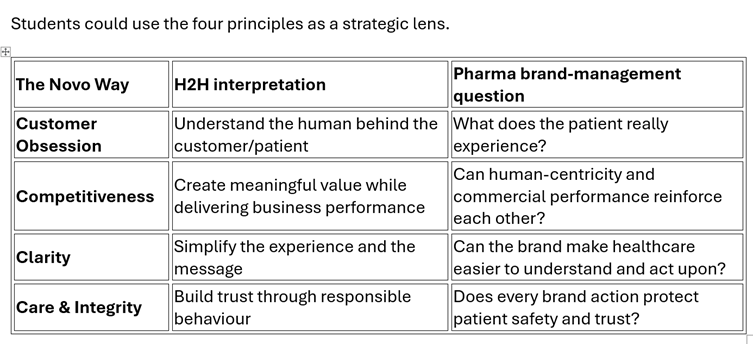
This table should be treated as an analytical interpretation for classroom discussion, rather than as Novo’s own stated H2H framework.
13. QUESTIONS FOR CLASSROOM DISCUSSION
Opening question
Is Novo’s announcement primarily a rebranding exercise, a cultural transformation, or both? Why?
Question 2
What is the difference between customer-centric, patient-centric and human-centric marketing?
Question 3
Does “Lasting Health Starts Now” represent a tagline, a brand promise, a corporate purpose, or something else?
Defend your answer.
Question 4
Which of the four principles of The Novo Way has the greatest potential impact on pharmaceutical brand management?
Students should support their answers with examples rather than simply selecting a principle.
Question 5
Can H2H marketing work in prescription pharmaceuticals, where the person who uses the medicine is often not the person who makes the prescribing decision?
Question 6
How would an H2H mindset change the work of a medical representative?
Question 7
How would it change the annual brand plan prepared by a brand manager?
Question 8
What could go wrong if H2H becomes merely a communication slogan rather than an organisational mindset?
Question 9
How could a pharma company measure whether it is genuinely becoming more patient-centric?
Question 10
What should Novo India do differently because it has adopted “Lasting Health Starts Now”?
14. THE BOARDROOM TEST
Ask students to imagine that they are presenting their recommendation to the Novo India leadership team.
The leadership asks them one final question:
“Tell us in one sentence what H2H means for a pharmaceutical brand manager.”
A strong student response might be:
“Stop thinking only about whom we sell to, and start thinking deeply about whom we serve.”
That sentence captures the central tension of the case.
15. TEACHING NOTE FOR THE FACULTY
This case can be used to teach several concepts simultaneously:
1. Corporate Rebranding
A rebrand is not necessarily about changing visual identity.
It can represent a change in how an organisation wants to be understood and experienced.
2. H2H Marketing
Kotler and his co-authors position H2H as a human-centric marketing approach that integrates Design Thinking, Service-Dominant Logic and digitalisation. (Springer)
3. Patient-Centric Marketing
Students can explore the difference between doing things for patients and designing value around patients’ lived experiences.
4. Brand Purpose
“Lasting Health Starts Now” provides an opportunity to discuss how a corporate idea can influence brand meaning.
5. Brand-Culture Alignment
The case demonstrates the relationship between external brand promise and internal organisational behaviour.
6. Pharmaceutical Ethics
“Care & Integrity” explicitly connects human-centricity with patient safety and ethics.
7. Strategic Consistency
Students can examine whether:
Purpose → Culture → Brand → Customer Experience → Patient Experience
should form one connected system.
16. THE TAKE-HOME LESSON
The most important lesson of this case may not be about Novo at all.
It is about the future of pharmaceutical marketing.
For years, pharma marketers have asked:
“How do I build my brand?”
The H2H mindset encourages a different question:
“How do I create meaningful value for the human being whose life my brand is trying to improve?”
That is a profound shift.
And it does not make science less important.
It gives science a human purpose.
It does not make the brand less commercial.
It challenges the brand to create value that people can genuinely experience.
And it does not replace patient-centric marketing.
It can take patient-centricity one step closer to being genuinely human-centric.
Novo’s own rebrand explicitly connects its new identity with bringing scientific breakthroughs closer to people’s everyday lives, while its new culture places consumers and patients at the centre and emphasises care, integrity and patient safety. (Novo Nordisk)
For the pharmaceutical brand manager of tomorrow, perhaps the most important question is therefore not:
“How do I make my brand more human?”
but:
“How human is the organisation behind my brand?”
That is where H2H meets pharma.
And that is where The Novo Way becomes much more than a corporate-values statement.
Suggested classroom format
I would teach this as a 90-minute Harvard-style case discussion:
10 min — Individual reading and reflection
15 min — Small-group analysis
20 min — H2H vs patient-centricity debate
20 min — “The Novo Way” brand-strategy exercise
15 min — India-specific application
10 min — Boardroom presentations and faculty synthesis
The case can also be converted into a 2-page student case + separate 3–4-page faculty teaching note, which would be even closer to the traditional Harvard case-method format.
Absolutely. I think the title should make the students curious before they even open the case. It should capture the emotional shift from product-centred pharma to human-centred pharma, while connecting Novo’s rebranding with Kotler’s H2H mindset.
My strongest recommendation
WHEN PHARMA PUTS PEOPLE FIRST
Novo’s Rebrand, the H2H Mindset and the New Face of Patient-Centred Marketing
This is powerful because it is simple, human and provocative. It also creates an immediate classroom question:
“Has pharma really been putting people first?”
Five more provocative alternatives
1. FROM MOLECULE TO HUMAN BEING
How Novo’s Rebrand Brings the H2H Mindset to Pharma Marketing
This is perhaps the most provocative for pharma brand-management students.
2. BEYOND THE BRAND: WHEN HEALTH BECOMES HUMAN
Novo’s Rebranding and the H2H Mindset in Pharmaceutical Marketing
More emotional and philosophical.
3. THE PATIENT IS NOT A PRESCRIPTION
What Novo’s Rebrand Teaches Us About H2H and Patient-Centred Pharma Marketing
This could generate an excellent classroom debate.
4. LASTING HEALTH STARTS NOW: BUT DOES HUMAN-CENTRIC PHARMA?
The Novo Rebrand Through the Lens of Kotler’s H2H Mindset
Very case-method oriented. It puts a question mark at the heart of the case.
5. FROM SELLING MEDICINES TO SERVING HUMANS
Novo, The Novo Way and the H2H Future of Pharma Marketing
Very clear and accessible for B-school students.
If you want something with real emotional punch
THE PATIENT IS NOT A PRESCRIPTION
How Novo’s Rebrand Brings the H2H Mindset to Pharmaceutical Marketing
It challenges one of pharma’s deepest habits.
A prescription is a commercial outcome.
A patient is a human being.
And that distinction is exactly where H2H thinking becomes relevant.
Novo’s new identity, “Lasting Health Starts Now,” puts the emphasis on lasting health and progress that people can see and feel in their daily lives. At the same time, The Novo Way explicitly places consumers and patients at the centre and combines this with competitiveness, clarity, care, integrity and an uncompromising commitment to patient safety.
That creates a beautiful strategic connection:
H2H Mindset
See the human. Understand the human. Create value for the human.
↓
Patient-Centred Marketing
Understand the patient’s life, not merely the disease.
↓
Novo Rebrand
“Lasting Health Starts Now.”
↓
The Novo Way
Customer Obsession + Competitiveness + Clarity + Care & Integrity
↓
The ultimate question for the pharma brand manager
Are we merely building brands, or are we improving human lives?
That, I believe, gives the case its emotional heart.
And it makes the case much bigger than Novo. It becomes a case about where pharmaceutical marketing needs to go next.
PS: What is this Apis Bull?
Encyclopaedia Britannica describes it thus:
Apis, in ancient Egyptian religion, sacred bull deity worshipped at Memphis.
The cult of Apis originated at least as early as the 1st dynasty (c. 2925–c. 2775 BCE).
Like other bull deities, Apis was probably at first a fertility god concerned with the propagation of grain and herds, but he became associated with Ptah, the paramount deity of the Memphite area, and also with Osiris and Sokaris, gods of the dead and of the underworld.