
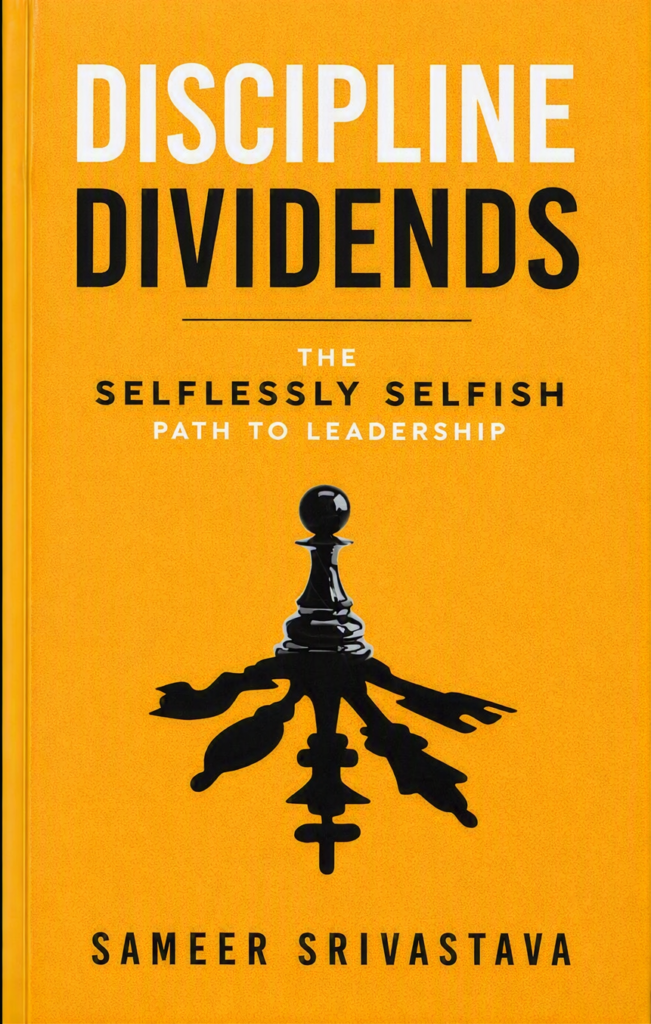
Discipline Dividends: The Selflessly Selfish Path To Leadership – Book Review
Authored By Sameer Srivastava
Preamble
Discipline Dividends: The Selflessly Selfish Path To Leadership By Sameer Srivastava
Can a self-help book teach you leadership without sounding like a management textbook?
Discipline Dividends: The Selflessly Selfish Path to Leadership, authored by Sameer Srivastava, does exactly that. It is a book about becoming a better person, a better professional and, ultimately, a better leader.
But what really caught my attention was something deeper.
Sameer brings Western management ideas such as Emotional Intelligence, self-awareness, purpose and WHY, associated with thinkers like Daniel Goleman, Jill Donahue and Simon Sinek, and places them comfortably alongside India’s ancient wisdom.
Every chapter begins with a verse from the Upanishads, followed by a simple interpretation. And then come the Ramayana, the Mahabharata and the Shrimad Bhagwad Gita.
Perhaps the West did not invent many of the leadership ideas we discuss today. We in India are rediscovering them.
May be this review is a 10-minute read, but the lessons from this book are eternal
Can a self-help book teach you leadership without sounding like a management textbook?
Discipline Dividends: The Selflessly Selfish Path to Leadership, authored by Sameer Srivastava, does exactly that.
It is a book about becoming a better person, a better professional and, ultimately, a better leader.
But what really caught my attention was something deeper.
Sameer brings Western management ideas such as Emotional Intelligence, self-awareness, purpose and WHY, associated with thinkers like Daniel Goleman Emotional Intelligence Courses Jill Donahue and Simon sinek and places them comfortably alongside India’s ancient wisdom.
Every chapter begins with a verse from the Upanishads, followed by a simple interpretation.
And then come the Ramayana, the Mahabharata and the Shrimad Bhagwad Gita.
Perhaps the West did not invent many of the leadership ideas we discuss today.
Perhaps we are rediscovering them.
What does “selflessly selfish” mean? Sameer puts it beautifully.
Help others in a way that also fills you up. Give because it feels good, not because you want applause.
Your kindness lifts them. And it lifts you too.
That is selflessly selfish.
He also challenges our obsession with multitasking.
Multitasking scatters attention weakens quality and drains energy.
Focus on your superpower. Go deep. Create an impact that divided attention simply cannot produce.
And here is one thought I loved:
One of the biggest killers of discipline is perfectionism.
How often do we delay action because we want everything to be perfect?
Discipline starts with the clock
Sameer says: master your sleep. Fix your bedtime. Fix your wake-up time.
This is a discipline I follow too.
I sleep by 9:30 p.m. and wake up at 3:30 a.m. My biological clock has now become my alarm clock. The next two and a half hours are reserved for work that needs deep thinking.
No email. No social media. No WhatsApp.
Then I am out for my one-and-a-half-hour workout.
The book also talks about Positive Energy versus Negative Energy and the Satva Principle.
Satva represents positive, pure energy that creates leadership presence.
Rajas creates restless energy.
Tamas represents negative and dulling energy.
The message is simple: Choose Satva every day.
Watch what it does to your life.
And then came Chapter 5.
My favourite. Self-awareness is perhaps the finest knowledge a human being can possess.
Sameer quotes the Aitareya Upanishad: “Pure self-awareness is the ultimate reality and the highest supreme Knowledge.”
Read pages 89 to 91. There are twelve gentle, practical ways to build self-awareness. And they made me look at myself.
For years, I believed I had a strong EQ. But I had not realised how low my self-awareness actually was.
Then, ten years ago, my youngest daughter Shailaja Dwivedi Pathak , just 24 at the time, did something extraordinary. Just as Jambavanta helped Bhagwan Hanuman discover his inner strength, Shailaja helped me discover my real worth in the pharma world.
She held up a mirror I had never dared to look into. For that, I remain deeply indebted to her.
What is your WHY?
Another chapter asks a deceptively simple question: Why are you doing all this?
Not the answer you give others. The deeper WHY. The WHY that gets you out of bed at 3:30 a.m. The WHY that keeps you steady during a tough review.
Sameer calls purpose the fuel that never runs out.
He reminds us that the Shrimad Bhagwad Gita is an eternal blueprint for discovering our WHY.
And then comes another simple but powerful idea: The Not-To-Do List.
Perhaps one of the most underrated tools of discipline.
Leadership is also about saying, “मैं हूँ ना.”
Chapter 10 touched me deeply.
Sameer talks about sacred relationships, relationships that uplift, protect and steady us.
Think about a junior who is tense, anxious or overwhelmed. Does he always need another lecture? Another review? Another target discussion? All he needs is your hand on his shoulder and three simple words: “मैं हूँ ना.” I am here.
Those words can give reassurance, safety and belonging.
Leadership is not only about targets and strategy. It is also about being present when someone needs you.
Your relationships are your greatest wealth.
And the same is true at home. Hust visualize your children are actually your teachers?
Chapter 11, inspired by the Katha Upanishad, took me somewhere very personal.
Two thoughts stayed with me: “Parenting is not just raising a child. It is raising a relationship that raises a child.”
And:
“पुत्रः-दुहिता परम गुरु:”
Our sons and daughters are our supreme gurus. We raise them. But they raise us too. They teach us patience. Humility. Adaptability. Unconditional love. And even, the courage to change ourselves.
And does parenting stop when our children turn 35 or 40? No! Of course not.
A 35-year-old daughter may no longer need her father to hold her hand while crossing the road. But perhaps one day, her father may need her hand to cross that road.
A 35-year-old son may no longer need his mother to pack his lunch. But he may still need a listening ear, a reassuring word, a warm hug, or simply the comfort of knowing:
“I am there for you.”
Parenting changes. Love does not.
We think we are raising our children. Our children are raising us too. That, to me, is the deeper meaning of:
“पुत्रः-दुहिता परम गुरु:”
We never stop being parents. Our children never stop being our children. Only the way we love each other changes.
On a personal note, my son Vibhav and my daughters Maanasi and Shailaja have been my truest teachers. They have shaped me in ways no B-school classroom ever could.
I have watched both my daughters discover the deep joy of parenting. But parenting also demands sacrifice.
For Maanasi, her first priority is her little son, followed by her profession as an architect.
And Shailaja Dwivedi Pathak , with tremendous courage, sacrificed her promising pharma career at a very young age to nurture her daughter. She wants to bring her daughter up in the rich traditions of Indian culture.
What profound lessons my पुत्रः-दुहिता have given me. They teach me every day what love, duty and inner strength really mean.
Popular leader or effective leader? Chapter 12 takes us to another uncomfortable question.
The Brihadaranyaka Upanishad says:
सत्याद्धि धर्मः भवति
From truth, dharma arises. Lead from the inside out. Because authentic leadership begins with authenticity.
Sameer makes an important distinction.
A popular leader wants everyone to like him. An effective leader wants his people to grow. Popularity may bring applause today. Effectiveness earns respect and delivers results over time.
I was fortunate to work with such a leader.
In the mid-1990s, when I was Group Product Manager at Alidac Genetics, a division of Cadila, It was a position equivalent to a National Sales Manager. I reported to O. P. Arya. He wanted me to be adept not only in brand management, but also in sales management and human resource management. To develop me, he entrusted me with the sales responsibilities of West Bengal and the Northeast in addition to my existing role. He was grooming me for future leadership.
O. P. Arya was an authentic leader. Both popular and effective.
And here is another uncomfortable truth. It is healthy to disagree with your boss. As long as the organisation’s vision and goals remain at the centre.
Do not become a “yes-man” simply to please your superior.
Shri Krishna could have told Arjuna whatever he wanted to hear. Instead, he gave him the hard truth of Dharma.
Yet in many corporates, leaders do not want to hear the truth.
So people tell the boss what the boss wants to hear.
But here is the question: Does that align with the dharma of being a true gatekeeper of the organisation?
Finally, this is not a book to read and forget.
The design itself is thoughtful.
Every chapter opens with a meaningful Upanishadic quote connected to the chapter’s theme.
And every chapter ends with three simple but powerful elements:
Key Questions.
A Commitment Page.
A 30-Day Tracker.
That is why DISCIPLINE DIVIDENDS does not feel like a book you read once and put away in your home library.
It feels more like the journal we kept during our college days.
Read one chapter.
Then give it thirty days.
Read it.
Absorb it.
Practise it.
Let it become part of you.
Leadership is not built by reading about leadership. It is built by living it. And perhaps that is the real dividend of discipline.
Not becoming a different person. By becoming a better version of the person, you already are.