
Lateral Thinking: A Key Skill for Every Pharma Manager – (Brand Management – 90)
Edward de Bono’s “Lateral Thinking” is a book about escaping the mental prison of “same old thinking.”
Edward de Bono shows that most people think in straight lines, follow habits, copy others, and repeat old ideas. But breakthrough success comes when someone dares to look at the problem differently.
This book teaches you how to break patterns, ask unusual questions, and discover opportunities others cannot see.
In a crowded world, lateral thinking helps you stand out instead of blending in.
Let us elaborate on this.
What is straight line thinking
What is ‘Straight Line Thinking’? Edward de Bono uses the word ‘Vertical Thinking’ in in his book.
It is when people:
- follow the same path,
- use the same assumptions,
- copy what others are doing,
- and search for answers only inside familiar boundaries.
Let’s take the latest example from our industry.
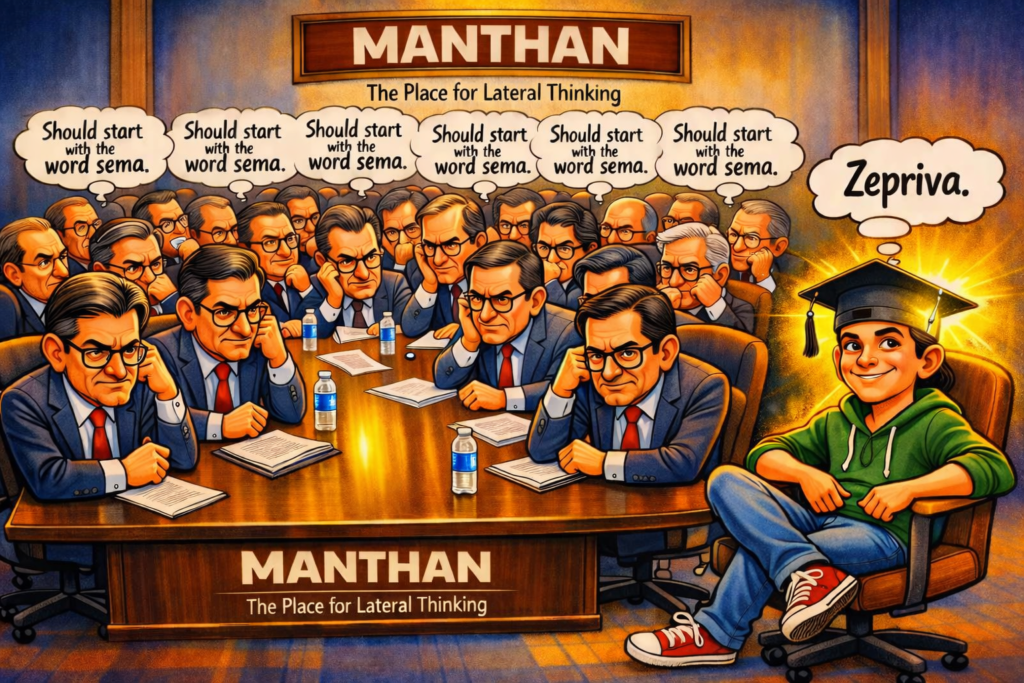
Over 30 pharma companies think:
“The generic molecule is semaglutide, so the brand name should begin with ‘Sema’… So easy for the doctors to recall.”
…that is straight-line thinking.
But stop and ask:
- “What if we choose a completely different name?”
- “What if distinction matters more than molecule recall?”
- “What if doctors remember freshness better than similarity?”
Straight-line thinking feels safe. But very often, it creates sameness.
Edward de Bono believed real breakthroughs happen when people step outside that straight line and look in a new direction.
Sometimes, problems cannot be solved by logic alone. We need fresh ideas. We need new ways of looking at things.
This is called lateral thinking.
Lateral thinking means:
- Looking at problems from different angles
- Breaking old patterns
- Asking unusual questions
- Finding unexpected solutions
The real story of Adhokshaja Haritas.
“First, let me congratulate you Adhokshaja Haritas.
Not because you gave a brand the name Zepriva.
But because, at the age of 23, you unknowingly escaped a mental trap into which dozens of experienced people had already fallen.
At times I wonder if Adhokshaja you are the Vaibhav Sooryvanshi of the pharma world. But many Vaibhav Sooryvanshi’s have burnt out early and I don’t want that to happen to Adhokshaja.”
So, what did Adhokshaja, an intern at B – Black Belt Brand Builders, do when working on his project on semaglutide?
The moment semaglutide lost its patent in India, 53 branded‑generic versions were ready to launch.
Most brand names started with “Sema…” because that is what doctors already know. “
It will be very easy for the doctor to remember our brand name,” thought Shivanand, Senior Vice President–Marketing of a large Indian MNC caught in this rat race.
But this is vertical thinking: “If doctors remember ‘semaglutide,’ then ‘Sema‑X’ will also be easy to recall.” And with this choice, Shivanand added one more ‘same‑looking’ brand to the crowded market.
In the heat of wanting to be the first to launch and grab the first‑mover advantage, he missed a crucial point: All the brands look the same. Doctors may get confused. No single brand stands out — except Novo Nordisk’s Ozempic and Wegovy.
But what did Adhokshaja do? He had not even read the book or heard of Edward de Bono. But he had a fresh raw mind. For his project, he coined the name Zepriva. (Later we found that this name hasn’t been registered by anyone). This means the rest of the brand managers and their seniors were thinking in a straight, vertical line.
Instead of “How can we remind doctors of semaglutide?” he asked: “How can we make this brand feel different, memorable, and ownable?”
By naming the brand Zepriva, what did Adhokshaja do?
- He avoided the “sema bandwagon.”
- Created a name that does not look like a copy of another brand.
- Unknowingly, he left space for a fresh STP, an unconventional story, image, and positioning around it.
This is exactly what De Bono calls lateral thinking: reframe the question, then solve it differently.
Why will reading the book “Lateral Thinking” help Adhokshaja in his career?
The book Lateral Thinking is not about “genius” ideas for once in a while. It is about making fresh thinking a habit. For Adhokshaja, it will help in three main ways.
A. Stand out in crowded markets.
- Markets are noisy. Many brands say the same thing and look the same.
- Lateral thinking helps you ask:
- “What is everyone else doing?”
- “Can I change the question itself?”
For example:
- Instead of “How can we copy Ozempic and Wegovy?”
- You think: “What job does this molecule really do for the patient?”
- Weight loss?
- Diabetes control?
- Confidence?
- Emotion?
Once you shift the question, you can position Zepriva not just as a “generic,” but as a different experience – maybe around ease of use, trust, or even simplicity of language.
B. Solve problems when logic is not enough.
In real life, not every problem has a clear, step‑by‑step answer. real life has:
- Deadlines.
- Limited budgets.
- Tough competitors.
Lateral thinking gives you tools.
- Random input: throw in a random word and connect it to the problem.
- Inversion: “What would make this fail?” then do the opposite.
- Changing the entry point: instead of starting from “how to get a prescription,” start from “how to stop the patient from quitting.”
When Adhokshaja reads De Bono, he slowly builds a toolkit for thinking. He will not rely just on instincts.
C. Adhokshaja will build a personal brand as a “different” thinker.
World over, companies today value people who can see patterns no one else sees.
If Adhokshaja keeps using lateral thinking:
- In brand names.
- In campaigns.
- In sales strategies.
“He becomes known as the person who opens new doors, not just follows the old ones.”
The book will help him:
- Name products that are ownable (people remember them).
- Create campaigns that stick (doctors, patients, and reps talk about them).
- Propose ideas that cannot be copied easily (because they come from a different angle).
How lateral thinking beats “disastrous vertical thinking”
Vertical thinking is still useful.
- It helps you follow rules, check data, and execute plans.
But when everyone thinks vertically?
- You get 53 brands with similar names.
- Similar messages.
- Similar doctor‑visit strategies.
That is disastrous vertical thinking:
- Safe.
- Predictable.
- Forgettable.
Lateral thinking offers:
- Fresh angles.
- Fewer copy‑cats.
- More ownable ideas.
In Adhokshaja’s case:
- Put 53 brands together and watch them melt into one big, flavorless blob. Nothing to see, nothing to remember.
- But Zepriva can carve its own space because it came from an unusual way of thinking.
How to use the book as a young career‑oriented person
Edward De Bono’s Lateral Thinking can be a kind of daily mental gym for Adhokshaja. Here is how he can use it:
A. Practice “idea generation” every day
- Read one chapter.
- Then apply it to one real problem:
- “How can I make this product launch different?”
- “How can I talk to a doctor differently?”
B. Train himself to re‑frame questions
De Bono teaches that the quality of your answer depends on the quality of your question.
- Vertical: “How can we increase prescriptions?”
- Lateral: “Why would a doctor want to start this patient today?”
Each time Adhokshaja changes the question, he opens a new path. static.ces.funai.edu+1
C. Treat failure as feedback, not stoppage
Lateral thinking encourages you to try odd ideas, then test them.
- Not every idea will work.
- But the habit of trying many angles will make him more resilient and creative over time.
In short, for Adhokshaja
Lateral Thinking by Edward De Bono will not make him a “genius;” it will make him a habitual original thinker. debono+1
- It will help him avoid the “sema bandwagon” in his career again.
- It will sharpen his instinct, like with Zepriva, into a repeatable skill.
- It will help him stand out in a crowded, noisy market, not just in India, but in his whole professional life.
An advice from Shailaja and I to Adhokshaja –
“You already showed lateral thinking once. Read this book to make sure you keep doing it for the next 30 years.”