
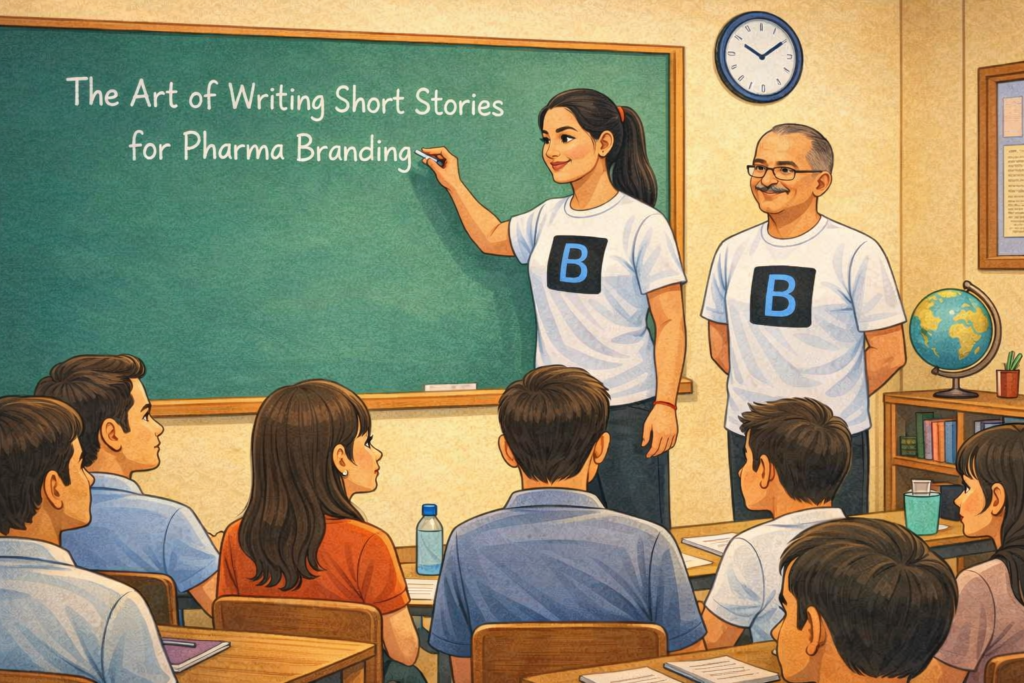
The Art of Writing Short Stories for Pharma Brand Managers – Brand Management 132
Developing very short stories is a powerful skill for Pharma India brand managers.
A short story is not an abridged article. It is a small moment from your life as a brand manager that teaches you something.
A simple formula is:
Character → Situation → Emotion → Insight → Brand/Marketing Lesson
Example 1: Doctor’s Waiting Room
Dr. Viraj Patel glanced at the glossy promo aid of Arthinut, a new arthritis nutra supplement, and put it aside.
But she paused when a patient described how morning stiffness prevented her from visiting the toilet.
That evening, Dr. Viraj read the promo, she scanned the QR Code and prescribed Arthinut.
Brands are remembered when they speak to life, not merely to disease.
Example 2: The Chemist
Chirayu, the pharmacist at Blueprint, noticed Prosenjitda, a 81-year-old buying Arthinut every week.
One day, he asked, “Are they helping you Prosenjitda?”
There was a big smile on his lips and eyes. “Of course! They help me walk to the park with my grandson every morning.”
Arthinut restore moments, not just mobility.
Example 3: The Brand Manager
After spending hours on Excel sheets, Veekas sighed.
“If I stop using my brain, my neurons will atrophy.”
He left his comfortable job in search of deeper thinking.
Creativity dies when managers become clerks and brands become spreadsheets.
Example 4: The Medical Representative
Raja Mukherjee, a medical representative celebrated exceeding his monthly target.
His district manager Salim Patel asked, “Wonderful. But which doctor changed his prescribing behavior, and why?”
Numbers tell us what happened. Curiosity reveals why it happened.
Seven sources for short stories:
- A conversation with a doctor.
- A patient’s struggle.
- A caregiver’s sacrifice.
- A pharmacist’s observation.
- A medical representative’s experience.
- A brand manager’s dilemma.
- An event from everyday life like a train journey, surgery, cricket match, or even making tea.
Think like a photographer, not a historian. Do not narrate the whole movie. Capture one frame that reveals a truth.
Many memorable management stories, from “Who Moved My Cheese?” to “Jonathan Livingston Seagull” and “The Four Agreements” derive their power not from length, but from the insight hidden inside a small human moment.
A good short story is like a prescription: short, precise, and capable of producing a lasting effect.
Over the years, I have found that pharmaceutical brand managers are surrounded by stories; they simply need to train themselves to notice them.
Here is another practical framework you may find useful:
The 5-S Formula for Short Stories
1. Scene – Where are we?
A crowded OPD. A chemist shop. A review meeting.
2. Someone – Who is involved?
A doctor. A patient. A caregiver. A medical representative.
3. Struggle — What is the problem?
Pain, anxiety, confusion, disappointment, or a business challenge.
4. Spark – What changed?
An observation. A question. A conversation. An insight.
5. Significance – What is the lesson?
The larger truth for branding, leadership, or marketing.
For example:
In one of our brand workshops, Rekha, a young brand manager proudly displayed a hundred-and -twenty slide presentation.
Shailaja quietly asked, “And what did you learn from meeting patients?”
There was silence in the room.
Brands are built less by PowerPoint slides and more by listening to human stories.
Keep a “Story Bank”
Shailaja always does this. She carries a small pocket slide and quickly enters into her he Evernote on her iPhone. She maintains a file with headings such as:
- Doctors
- Patients
- Caregivers
- Pharmacists
- Medical Representatives
- Brand Managers
- Competitors
- Mistakes
- Insights
- Everyday Life
Whenever something catches her attention, she jots down:
- Who?
- What happened?
- What emotion did you observe?
- What larger truth does it reveal?
Eventually, she discovered that she is not “writing” stories. She is harvesting them.
As Leo Tolstoy observed:
“The strongest of all warriors are these two; Time and Patience.”
Storytelling works the same way. Small observations, patiently collected, become powerful stories. And powerful stories, patiently repeated, become memorable brands.
A Stiff Challenge
During a brand managers’ residential workshop at Lonavala a few weeks ago, we threw a tough challenge at the young participants.
Shailaja asked them to craft a story, under 50 words, built around five generics and five popular brands.
- Semaglutide for diabetes management
- Semaglutide for weight management
- Vonoprazan in GERD
- Vonoprazan vs. PAN-40
- Azithromycin
- Zincovit
- Augmentin
- Becosules
- Orofer XT
- Thyronorm
We also told them to suggest a brand name for the generics. Here is the outcome
1. Semaglutide for Diabetes Management
Brand name: 9to5
Ramesh got his HbA1c test, his ninth in nine months. HbA1c count 9.1.
Hardly any change.
His doctor suggested 9to5 Injections (semaglutide). He told Ramesh: “steady progress, not sudden miracles.”
Six months later, Ramesh noticed calmer mornings and fewer spikes. The HcAc1 count was 5.2
For the first time in years, he felt in control, not controlled by diabetes. The
2. Semaglutide for Weight Management
Brand name: Vazankam. We loved it
Meera avoided looking at mirrors.
Diets came and went; hope faded quickly.
Her doctor introduced Vazankam Injections (semaglutide), explaining it as a partner, not a shortcut.
Slowly, her clothes loosened, her breath eased, and her confidence returned.
One morning, she smiled at her reflection progress finally felt possible.
At 5’8” she was now 68 kg.
3. Vonoprazan in GERD
Brand name: Zock
Dr. Iyer watched Patrick describe nightly burning that stole sleep and peace.
A cup of chilled Amul milk had helped, but not enough.
He now prescribed Zock – 10 (vonoprazan).
A week later, Patrick returned with a relaxed face and grateful eyes. “I slept,” he said simply.
Sometimes relief is just that simple.
4. Vonoprazan vs. Pantoprazole
For months, PAN-40 kept Anita’s acidity manageable, but flare‑ups still broke through. Her doctor switched to Zock – 10 (vonoprazan), hoping for deeper control.
Within days, the sharpness eased, meals felt normal again, and nights were quiet.
She realised the right molecule doesn’t just treat symptoms; it restores routine.
5. Azithromycin
Brand Name: A-3
Rahul’s fever had drained him for days. His doctor prescribed A-3, reliable, steady, familiar.
By the third day, Rahul felt energy returning, appetite waking, and life resuming its rhythm. He realised that in moments of illness, trust often lies in medicines that have stood the test of time.
6. Zincovit
During monsoon season, Dr. Shah saw tired faces and low immunity everywhere.
Nandita, a 28-year-old mother said, “I can’t afford to fall sick.”
He recommended Zincovit to rebuild her strength.
Weeks later, she returned brighter, saying she finally felt “charged from inside.” Sometimes vitality begins with small essentials.
7. Augmentin
Little Aarav clung to Samikshya, his mother.
Aarav was exhausted from stubborn tonsilitis. Dr. P. C. Mehta prescribed Augmentin, confident in its broad, dependable cover.
Two days later, Aarav was laughing again, chasing his toy truck.
His mother whispered thanks sometimes the strongest reassurance is a medicine that brings childhood back.
8. Becosules
Shalini pushed through long workdays, ignoring her fatigue.
When mouth ulcers and weakness followed, her doctor suggested Becosules to replenish what stress had drained.
Within a week, her spark returned. She realised energy isn’t luxury, it’s fuel, and sometimes it begins with restoring simple deficiencies.
9. Orofer
Sushma thought her tiredness was “just life.” But her reports showed iron deficiency.
Orofer became part of her routine. Slowly, her breath steadied, her steps felt lighter, and colours seemed brighter.
She understood that treating anemia isn’t about tablets, it’s about reclaiming daily strength.
10. Thyronorm
For years, Kavita lived with unexplained sluggishness.
When hypothyroidism was diagnosed, Thyronorm became her morning companion.
Weeks later, she felt her rhythm returning, clearer thoughts, steadier moods, renewed energy. She realised balance isn’t dramatic; it’s the quiet return of normalcy.
Shailaja later challenged them further. “Now create a 25-word story”
And this is how they responded
1. Semaglutide – 9to5
Dr. Rao saw uncontrolled sugars despite effort. He started 9to5 for steadier control. Weeks later, Ramesh returned calmer, mornings smoother. Progress finally felt real.
2. Semaglutide – Vazankam
Dr. Mehta sensed Meera’s frustration with repeated weight failures. He prescribed Vazankam Gradually, her energy rose and confidence returned. Small wins became visible hope.
3. Zock – GERD
Dr. Iyer heard nightly burning stealing sleep. PPIs weren’t enough. He prescribed vonoprazan. A week later, Patrick smiled. “I finally slept.” Relief felt immediate.
4. Zock-10 vs PAN-40
PAN-40 helped Anita partially. Breakthrough acidity persisted. Dr. Shah switched to vonoprazan. Soon, meals felt normal and nights quiet. The right brand, Zock=10 restored routine.
5. A-3
Dr. Verma chose A-3 for Rahul’s stubborn fever. By day three, energy returned and appetite revived. Familiar reliability restored rhythm quickly.
6. Zincovit
During monsoon fatigue, Dr. Shah recommended Zincovit to a drained young mother Nandita. Weeks later, she returned brighter, saying she felt “recharged from inside.”
7. Augmentin
Little Aarav’s infection lingered. Dr. Mehta prescribed Augmentin with confidence. Two days later, Aarav was laughing again. Recovery brought childhood back.
8. Becosules
Shalini’s fatigue and signalled depletion of energy. Dr. Rao advised Becosules. Soon, her spark returned. Replenishing basics restored her energy.
9. Orofer
Sushma’s short breath and tiredness puzzled her. Reports showed iron deficiency. Dr. Kulkarni started Orofer-XT. Gradually, breath steadied and strength returned. Life felt lighter.
10. Thyronorm
Kavita’s sluggishness persisted for years. Diagnosis confirmed hypothyroidism. Dr. Iyer began Thyronorm. Weeks later, clarity and energy returned. Balance quietly restored her routine.
Conclusion
We both loved the final outcome. Their short stories made one truth clear: when you push people into the water, they discover they can swim. That is exactly what we did. And it worked.
If we want outstanding, future‑ready pharma leaders, we must give them space to think, explore, and try. Not hand them ready‑made templates that turn bright minds into data‑entry operators.
Growth happens when people stretch beyond comfort. Confidence grows when they create, not copy.
The future will belong to those who are trusted to think boldly and act with courage.
.