
Why Isn’t Pharma Getting Impatient for Results? Brand Management 130
Can Pharma Grow Exponentially, Not Just Incrementally?
At the height of Covid, in June 2020, I was chatting on WhatsApp with my close friend Nandan.
He lives in Bangalore and works in the IT industry at Accenture.
I proudly told him how pharma in India is growing agai, touching 15% and returning to double‑digit growth. I expected him to be impressed.
Instead, via emoticons, Nandan gave a loud, teasing laugh.
“Vivek,” he said, “the problem with pharma people is simple. You think too small. You think incrementally, not exponentially. Tell your students to throw their incremental mindset into the Indian Ocean. And before you tell them, you do it first!”
I was stunned.
Nandan didn’t stop.
“You keep praising pharma growth. But Google, Amazon and others are waiting around the corner. They will turn pharma into a dinosaur. And you don’t even see it happening!”
Then he delivered the knockout punch.
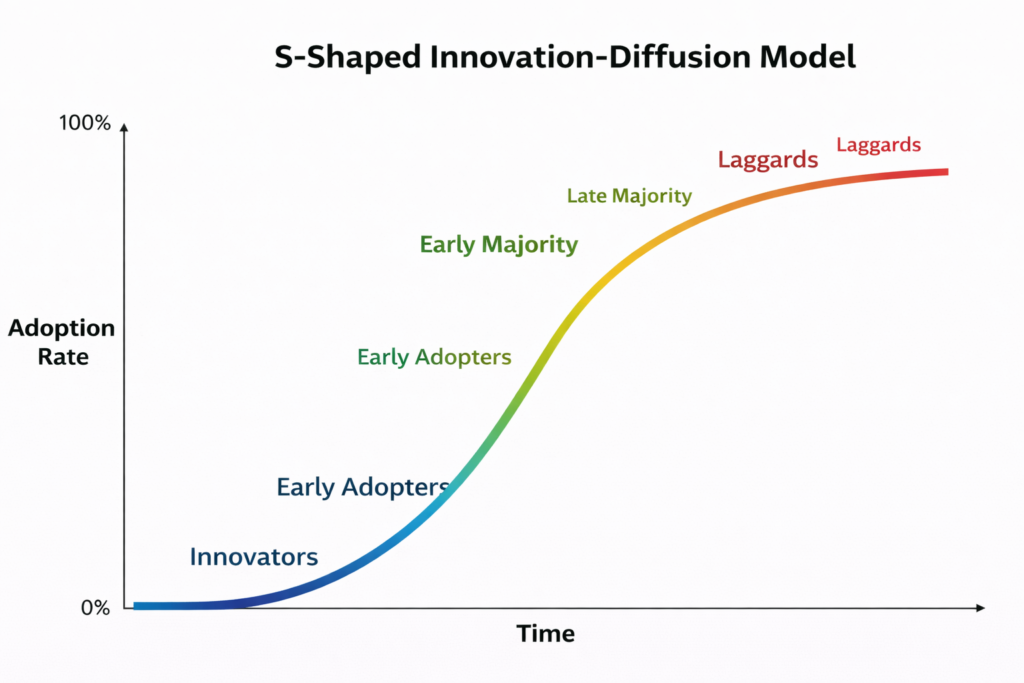
“You are still teaching the old S‑shaped Innovation‑Diffusion Model. But the world has changed. The ‘S’ is becoming an I‑shape, almost a straight vertical line. Read the essay on technology adoption by Hannah Ritchie and Max Roser. You’ll understand.
People today adopt new technology at lightning speed. We live in a SoLoMo world — Social, Local, Mobile. But you are still celebrating 1.15X growth when the world is thinking 15X!”
That hit me hard.
Not a slap, a full‑force knock.
I read that essay.
This essay said: “Many teachers and textbooks still explain innovation using the old S-shaped curve. According to this model, new technologies are adopted slowly at first, then more quickly, and finally the growth slows down.
But today’s world is different. New technologies are spreading much faster than before. Instead of an “S”, the adoption curve is beginning to look like an “I” — almost a straight vertical line.
In other words, technologies that once took decades to become popular are now reaching millions of users within a few years, sometimes even months.
This change has been highlighted by Hannah Ritchie and Max Roser in their essay on technology adoption. Their work shows that the speed of innovation diffusion is accelerating, forcing businesses, educators, and leaders to rethink many of their old assumptions.
For me, a memorable way to express it is: “Yesterday’s innovations walked. Today’s innovations run. Tomorrow’s innovations may fly”
I couldn’t sleep.
At 3 a.m., I woke up and started writing this piece.
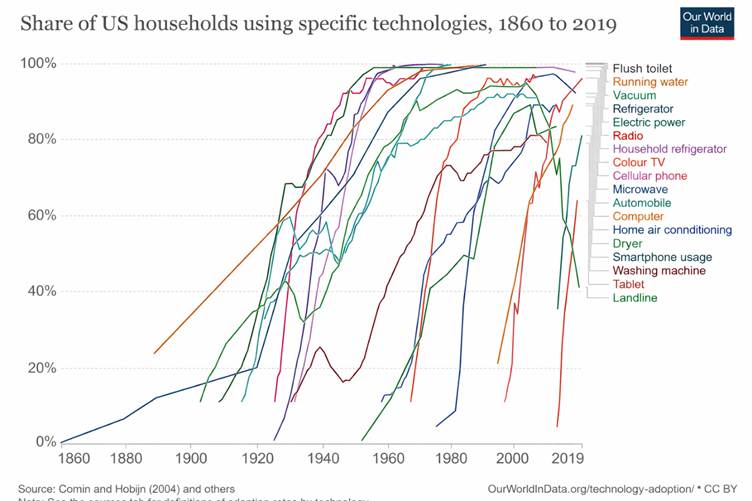
I looked again at the Innovation‑Diffusion chart from 1860 to 2019.
The landline phone shows the classic slow ‘S’ curve.
But the smartphone curve shoots up like a tilted ‘I’.
Why?
Because people today think exponentially.
But pharma is still stuck in the comfort of incremental thinking.
So how do we build an exponential mindset?
Mark Bonchek explains it beautifully in Harvard Business Review:
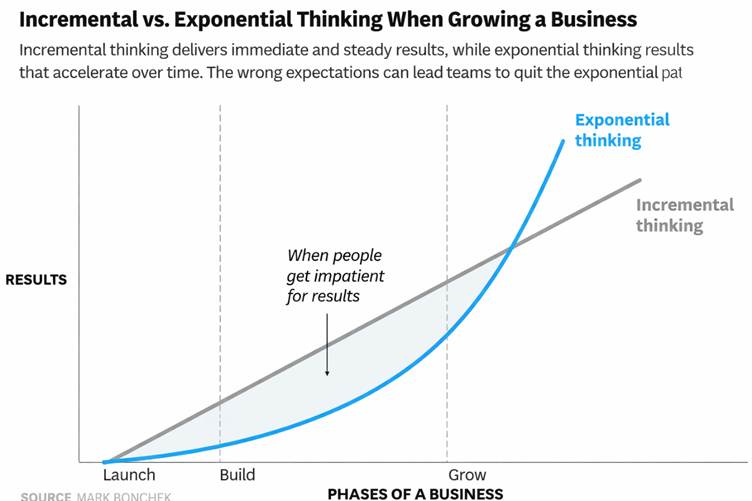
“Incremental thinking makes something better.
Exponential thinking makes something different.
Incremental is happy with 10%.
Exponential aims for 10X.”
That line stayed with me.
Everett Rogers said innovation spreads through communication, time, and social influence.
But today, digital and phygital innovations spread on their own — fast, wide, unstoppable.
Vivek Wadhwa, in his book From Incremental to Exponential, writes:
“When multiple fast‑moving technologies merge, the result is even faster improvement.”
Exactly.
That is the world we live in.
So as India enters its 73rd year as a Republic, here is my humble wish for our great nation:
Let us shift from the Incremental Mindset to the Exponential Mindset.
Imagine if pharma grows not 15%… but 15X.
Imagine the jobs we will create.
Imagine the innovation we will unlock.
To do that, we must unlearn the comfortable and familiar ways of thinking.
That is the biggest gift we can give to Bharat Mata.
As Mark Bonchek reminds us:
“When we shift from incremental to exponential, real innovation becomes possible.”