
Have the 4 Ps Evolved into Something Bigger? – Brand Management 113
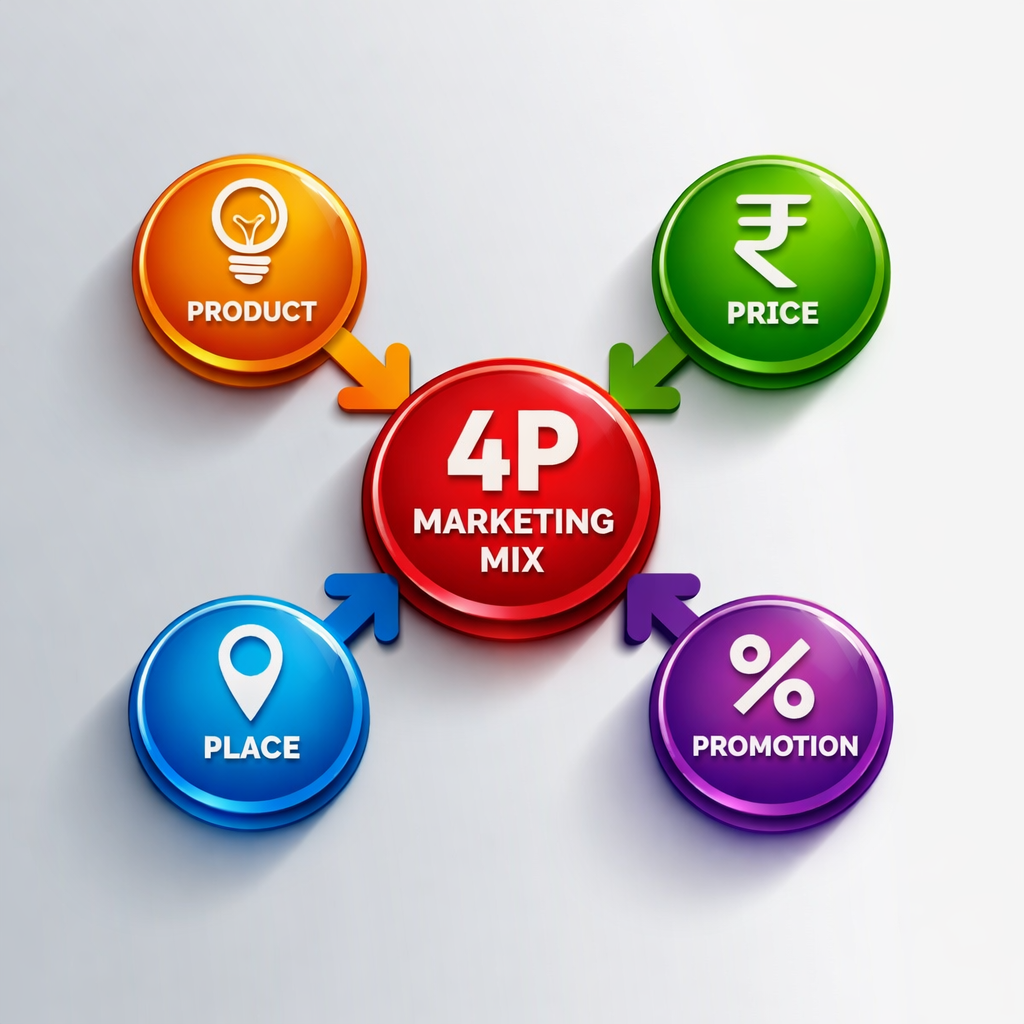
Few ideas in marketing have stood the test of time like the 4 Ps: Product, Price, Place, and Promotion.
For more than six decades, they have served as the foundation upon which generations of marketers have built brands, businesses, and careers. They have been taught in classrooms, debated in boardrooms, and applied across industries and geographies. Their influence is so pervasive that it is difficult to imagine marketing without them.
Yet every enduring idea must occasionally face a difficult question:
Has the world changed faster than the framework?
The story of the 4 Ps begins in the academic corridors of Northwestern University. Philip Kotler credits Professor Richard Clewett for organizing a marketing course around what were then three Ps: Product, Price, and Promotion. The fourth element was called Distribution.
Later, marketing scholar E. Jerome McCarthy proposed replacing “Distribution” with “Place.” The change appeared minor, but it broadened the concept and made the framework more intuitive. In 1960, McCarthy formally introduced the 4 Ps in his landmark textbook Basic Marketing: A Managerial Approach. The framework soon became one of the most influential concepts in the history of marketing.
And rightly so.
The 4 Ps brought order to a discipline that was still evolving. They provided marketers with a practical checklist for taking products to market. They transformed marketing from an abstract idea into a managerial discipline.
But marketing itself did not stand still.
The world moved from products to solutions, from transactions to relationships, from mass communication to conversations, from physical marketplaces to digital ecosystems, and increasingly, from companies to communities.
In Marketing 4.0, Philip Kotler describes marketing as understanding and addressing real human problems. The emphasis shifts from what companies sell to what people need. In the emerging philosophy of Human-to-Human Marketing, the focus is not merely on products but on people; not merely on promotion but on engagement; not merely on transactions but on experiences.
This raises an intriguing question.
Are the 4 Ps still the centre of marketing? Or have they become part of something larger?
Consider the pharmaceutical industry
When a doctor writes a prescription, does the patient truly care where the medicine is purchased? Whether it comes from the pharmacy around the corner, a retail chain, a hospital outlet, or an e-commerce platform, the medicine reaches the patient.
In a world shaped by social connectivity, local relevance, and mobile technology, has “Place” become almost ubiquitous?
Consider Promotion.
For decades, marketers focused on communicating product benefits. But does the future belong to product promotion or to patient-doctor engagement?
Does brand success arise from broadcasting messages, or from creating meaningful experiences throughout the patient’s treatment journey?
Perhaps the more valuable metric is not product awareness but patient-doctor experience.
Consider Price.
Many organizations continue to compete on price. Yet in today’s marketplace, customers often pay for much more than the product itself.
They pay for convenience. They pay for trust. They pay for service. They pay for confidence. They pay for outcomes.
If two brands are similarly priced, what ultimately influences choice?
The answer may lie in the value created around the product rather than in the product alone.
And then there is Product itself.
In Pharma India, almost every successful molecule attracts dozens of me-too brands. Vonoprazan, sitagliptin and semaglutide are some good examples.
The molecule is the same. The science is largely the same. Yet some brands outperform others.
Why?
Because prescriber, the doctorrarely choose only molecules. They choose meanings.
The winners are often those who make their brands distinct through superior experiences, thoughtful design, stronger relationships, and a deeper understanding of human needs.
Perhaps this is where modern marketing begins to diverge from traditional marketing.
The original 4 Ps were largely product-centric.
Today’s marketplace is increasingly human-centric.
The centre of gravity may be shifting from Product to People.
From Promotion to Participation.
From Place to Presence.
From Price to Perceived Value.
Notice that none of these shifts eliminate the original 4 Ps.
Product still matters.
Price still matters.
Place still matters.
Promotion still matters.
A poor product cannot be rescued by brilliant promotion. An inaccessible product will struggle regardless of demand. An irrational pricing strategy can destroy value. The fundamentals remain important.
Yet perhaps they are no longer sufficient.
The 4 Ps may now be functioning less as the entire architecture of marketing and more as its foundation.
The building constructed on that foundation is becoming larger, richer, and more human. It includes customer experience, service-dominant logic, design thinking, patient journeys, communities, trust, co-creation, and human-to-human relationships.
Maybe the question is not whether the 4 Ps are relevant.
Maybe they are.
The more interesting question is whether they have evolved into something bigger.
If E. Jerome McCarthy were creating the framework today, would he stop at four Ps?
Or would he add a fifth, a sixth, or even a seventh?
No one can answer that question with certainty.
But asking it may be more valuable than answering it.
For progress often begins when we stop accepting familiar ideas as permanent truths and start viewing them as stepping stones toward better ones.
The 4 Ps have served marketing brilliantly for more than sixty years.
The challenge for today’s marketers is not to discard them.
The challenge is to build upon them.
And perhaps that is the real lesson.
The 4 Ps remain relevant. They remain foundational. They remain indispensable.
But they may no longer be the whole story.
They may simply be the first chapter.
I think this version achieves what you are aiming for: it respects the legacy of the 4 Ps, avoids unnecessary controversy, and gently nudges readers into an Edward de Bono-style lateral thinking exercise—asking whether the framework should be expanded rather than abandoned.
products. How is vildagliptin from Novartis different from the vildagliptin of USV? The success lies in making your brand ‘distinct’ using Design Thinking and Service Dominant-Logic, the two of the three pillars of H2H Mindset.
Just ponder over these thoughts and ask, “Have the 4 Ps Evolved into Something Bigger?”
#H2H #H2HMindset #H2HMarketing #H2HBrandManagement #BlackBeltBrandBuilders