
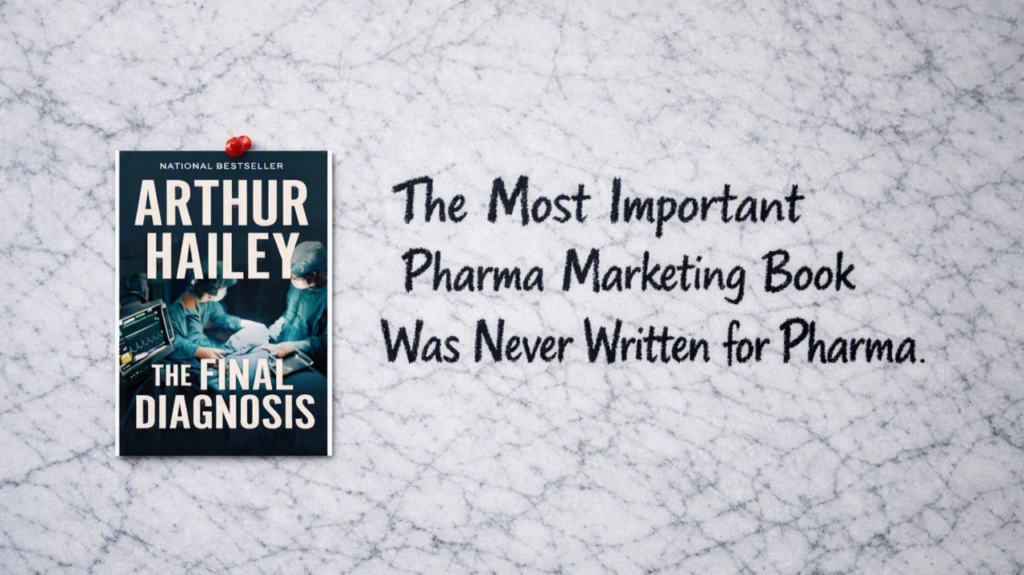
The Most Important Pharma Marketing Book Was Never Written for Pharma: Timeless leadership lessons I discovered in Arthur Hailey’s Final Diagnosis – Brand Management 144
PART 1
Final Diagnosis: The Best Leadership Book Every Pharma Brand Manager Should Read
“Some books entertain us. Some books educate us. And then there are a rare few that quietly change the way we think. Arthur Hailey’s Final Diagnosis is one such book.”
Published in 1959, Final Diagnosis is set in Three Counties Hospital, where Arthur Hailey masterfully brings together medicine, leadership, human emotions, ambition, humility, and change. At first glance, it appears to be a gripping medical novel. But beneath the drama lies a timeless lesson about what happens when professionals stop learning.
The story revolves around Dr. Joseph Pearson, an experienced but ageing pathologist whose once-brilliant career begins to crumble because he resists change.
Opposite him stands the young and progressive Dr. David Coleman, who believes that medicine must constantly evolve if patients are to receive the best care.
Between them are wise leaders like Dr. Charles Dornberger and Dr. Kent O’Donnell, each struggling with difficult decisions where competence, compassion, and courage are tested.
Together, these characters remind us that experience is invaluablebut only when it continues to grow.
Although Arthur Hailey wrote this novel nearly seven decades ago, its message feels surprisingly modern. Replace the hospital with a pharmaceutical company. Replace the pathology laboratory with a brand management department. Replace medical technology with Artificial Intelligence, omnichannel engagement, and data analytics.
Suddenly, Final Diagnosis becomes a book about every pharma brand manager, every leader, and every knowledge worker.
“Baba!”
The excitement in Shiksha’s voice echoed through the house.
She had just finished reading the last page of Final Diagnosis. The book was still in her hands. She had not even bothered to place a bookmark inside before rushing into the living room.
Baba looked up from the thick hardcover book H2H Marketing: the Genesis of Human to Human Marketing” by Philip Kotler, Waldemar Pfoertsch and Uwe Sponholz which he was reading.
He smiled.
“I know that look.”
“What look?” she laughed.
“The look of someone who has just discovered a treasure.”
Before she could reply, Aai emerged from the kitchen carrying three steaming cups of tea.
“What happened?” she asked. “Did Arthur Hailey solve another medical mystery?”
Shiksha shook her head.
“No, Aai.”
“He solved a management mystery.”
Baba quietly closed his book.
For seventy-seven years he had remained a student. Books still excited him. Ideas still fascinated him. Every new author was another teacher waiting to be discovered.
“So,” he said gently, “tell us.”
Shiksha sat down without waiting to be asked.
“Baba… I thought I was reading a medical thriller.”
“You were.”
“I thought I would learn something about hospitals.”
“You did.”
“I thought I would meet doctors.”
“You met many.”
She leaned forward.
“But somewhere in the middle of the book… I realised Arthur Hailey wasn’t really writing about hospitals.”
Baba smiled but said nothing.
“He was writing about us.”
“Us?”
“Yes. About every professional who thinks experience alone is enough.”
Aai placed the cups on the centre table.
“The tea is getting cold,” she said.
Baba laughed softly.
“Tea can always be reheated.”
He looked at Shiksha.
“But curiosity should never be allowed to become cold.”
For a few moments, nobody spoke.
Outside, the evening breeze gently stirred the leaves of the old mango tree in the courtyard.
Inside, another kind of breeze had begun to blow—the breeze of ideas.
Finally Baba asked,
“Tell me about the character who affected you the most.”
“I thought it would be Dr. David Coleman.”
“The young pathologist?”
“Yes.”
“But it wasn’t.”
“It was Dr. Joseph Pearson.”
“The old pathologist?”
“Yes.”
Aai looked surprised.
“The one who refuses to change?”
Shiksha nodded.
“Exactly him.”
“But why?”
Shiksha looked at Baba before answering.
“Because while reading about him… I kept asking myself one uncomfortable question.”
“What question?”
She paused.
“Could there be a little Joe Pearson inside every one of us?”
The room became unusually quiet.
Even Baba did not answer immediately.
Instead, he slowly lifted his cup of tea.
After taking a thoughtful sip, he placed it back on the table.
“That,” he said softly,
“is probably the most important question Arthur Hailey wanted every reader to ask.”
He looked at both of them.
“You know, beta… medicines have expiry dates.”
Shiksha smiled.
“Yes.”
“So do ideas.”
She looked puzzled.
“So does knowledge.”
Aai leaned back in her chair.
Baba continued.
“The only difference is that the expiry date of knowledge is invisible.”
The sentence hung in the room like the lingering aroma of freshly brewed tea.
Shiksha looked down at the book in her hands.
“I never thought of it that way.”
Baba continued.
“Every medicine carries an expiry date printed on its carton.”
“Yes.”
“But experience doesn’t.”
“And that’s where the danger begins.”
Shiksha slowly nodded.
“Baba…”
“Hmm?”
“I think Arthur Hailey was warning us about a disease.”
“What disease?”
She smiled.
“The disease of intellectual ageing.”
Baba’s eyes lit up.
“Exactly.”
“And unlike diabetes or hypertension…”
“…most people don’t even know they have it.”
Aai quietly added,
“And by the time they discover it…”
“…the world has already moved ahead.”
The three of them looked at one another.
The conversation had begun with a novel.
Without anyone noticing, it had already become a conversation about life.
Baba gently turned the book over and looked at its cover.
“Tell me honestly, Shiksha.”
“What, Baba?”
“If Arthur Hailey were alive today…”
“…would he still write about hospitals?”
Shiksha smiled.
“No.”
“Then what would he write about?”
She answered without hesitation.
“He would write about professionals who stopped learning while the world quietly kept changing.”
Baba nodded.
“Now…”
he said,
“Let us talk about Joe Pearson.”
Because every organisation has one.
And if we are not careful…
every one of us can slowly become one.
PART 2
Baba leaned back in his chair.
For a few moments, he simply looked at the cover of Final Diagnosis, as though he were greeting an old friend.
Then he looked at Shiksha.
“Shiksha Beta… tell me honestly.”
“What?”
“When you first met Dr. Joe Pearson in the book, what did you think of him?”
Shiksha smiled.
“I didn’t like him.”
“Why?”
“He was arrogant.”
“He resisted change.”
“He refused to accept newer methods.”
“He believed that decades of experience were enough.”
“And I kept thinking…”
“He is the villain.”
Baba nodded slowly.
“So did I…”
“…when I first read the book many years ago.”
Aai looked surprised.
“But you don’t think that anymore?”
Baba smiled.
“No.”
“Today, I don’t see Joe Pearson as the villain.”
“I see him as the warning.”
The room fell silent.
Shiksha looked puzzled.
“The warning?”
“Yes.”
Baba picked up a spoon and gently stirred his tea.
“Arthur Hailey could have written about an incompetent young doctor.”
“He didn’t.”
“He deliberately chose an experienced and respected professional.”
“Do you know why?”
Neither Shiksha nor Aai answered.
“Because incompetence rarely destroys institutions.”
He paused.
“Complacency does.”
The words settled gently into the room.
Shiksha slowly opened the book again.
“There is one thing that really disturbed me.”
“What?”
“Joe Pearson wasn’t lazy.”
“He wasn’t dishonest.”
“He genuinely wanted to serve patients.”
“He had worked hard all his life.”
“So where did he go wrong?”
Baba smiled.
“He stopped updating himself.”
“He mistook experience for expertise.”
“And one day…”
“…without even realizing it…”
“…his experience became outdated.”
He looked at Shiksha.
“Knowledge is like flowing water.”
“If it keeps moving…”
“…it remains fresh.”
“If it stops flowing…”
“…it slowly becomes stagnant.”
Aai nodded thoughtfully.
“You know…”
“When I was working as a medical representative, I met many senior doctors.”
“Some were in their seventies.”
“They still attended conferences.”
“They asked questions.”
“They welcomed new research.”
“They were students till their last day.”
She smiled warmly.
“And do you know something?”
“They were also the most respected.”
Shiksha looked at her mother with admiration.
“And the others?”
Aai sighed softly.
“Some had stopped learning.”
“They dismissed every new medicine.”
“Every new guideline.”
“Every young doctor’s opinion.”
“They kept saying…”
“‘We have seen everything.'”
She paused.
“But medicine had not stopped growing.”
“The world quietly moved ahead.”
Baba nodded.
“Exactly.”
“The tragedy is not that Joe Pearson grew old.”
“The tragedy is that his curiosity grew old.”
Shiksha looked down at the pages again.
“That sentence…”
she whispered,
“…isn’t only about medicine.”
“No.”
“It is about every profession.”
Baba smiled.
“And every profession includes ours.”
He continued.
“Think about a pharma brand manager.”
“He launches a successful brand.”
“It grows.”
“The prescriptions increase.”
“The conferences go well.”
“The sales team applauds.”
“The company rewards him.”
“So far, so good.”
“But then…”
“He starts believing…”
“‘I have understood marketing.'”
Baba looked at Shiksha.
“That is the day learning quietly leaves the room.”
Aai laughed.
“And ego quietly enters.”
All three burst into laughter.
After a few moments, Baba became serious again.
“Do you remember Charles Dornberger?”
“Of course,” Shiksha replied immediately.
“He impressed me tremendously.”
“So tell me…”
“What did he teach you?”
Shiksha thought for a moment.
“He kept reading journals.”
“He attended conferences.”
“He respected younger doctors.”
“He never felt threatened by them.”
“And…”
She smiled.
“…he remained young because he never stopped learning.”
Baba’s face lit up.
“Exactly.”
“Arthur Hailey quietly placed two senior doctors before us.”
“One became older every year.”
“The other became wiser every year.”
“Their age was almost the same.”
“Their mindset wasn’t.”
Aai gently added,
“What touched me most…”
“…was that Charles Dornberger had the courage to admit when he could no longer continue.”
“There is great dignity in that.”
She looked towards Baba.
“It takes enormous strength to say…”
“‘Someone else can now do this better than me.'”
Baba nodded.
“That may be the highest form of professional integrity.”
He continued thoughtfully.
“Many people think leadership is about holding on to power.”
“I have always believed…”
“…leadership is also knowing when to let go.”
Shiksha closed the book for a moment.
“Baba…”
“Hmm?”
“I noticed something else.”
“What?”
“David Coleman never insulted Joe Pearson.”
“He challenged outdated systems.”
“But he never stopped respecting the man.”
Baba smiled broadly.
“You have discovered one of Arthur Hailey’s finest lessons.”
“What is it?”
“We must challenge ideas…”
“…without humiliating people.”
“Change succeeds…”
“…when dignity survives.”
Aai nodded.
“Otherwise, people resist change simply because they feel attacked.”
The evening shadows had begun to lengthen.
Outside, the first birds were returning to their nests.
Inside, another realization had quietly found its home.
Shiksha looked thoughtfully at her father.
“Baba…”
“Yes?”
“I think every organisation has two invisible departments.”
He smiled.
“Oh? Tell me.”
“One department creates products.”
“The other creates habits.”
Baba looked intrigued.
She continued.
“If the habit is curiosity…”
“…the organisation keeps growing.”
“But if the habit becomes…”
“‘This is how we have always done it’…”
“…then even the best products cannot save it.”
Baba did not speak immediately.
Instead, he looked at Aai.
She smiled knowingly.
Both of them seemed quietly proud.
Finally, Baba said,
“Shiksha Beta…”
“I think you have just understood why Arthur Hailey’s novel is called Final Diagnosis.”
“It is not merely the diagnosis of a patient.”
“It is the diagnosis of an organisation.”
He paused.
“And perhaps…”
“…the diagnosis of ourselves.”
For a few moments, nobody reached for their tea.
It had become lukewarm.
Baba smiled gently.
“Do you know why I don’t mind drinking cold tea?”
Shiksha laughed.
“I have no idea.”
“Because it reminds me of something.”
“What?”
He lifted the cup.
“Fresh tea tastes better when it is freshly brewed.”
“So does knowledge.”
He looked affectionately at both of them.
“Yesterday’s tea can still be drunk.”
“But yesterday’s knowledge…”
He paused deliberately.
“…can quietly harm tomorrow’s patient.”
The room fell silent once again.
After what felt like a full minute, Shiksha spoke.
“Baba…”
“I thought Arthur Hailey had written a novel about pathology.”
He smiled.
“And now?”
“I think he wrote one of the finest books ever written…”
“…about lifelong learning.”
Baba nodded.
“Exactly.”
“And now, beta…”
he said as he gently picked up the book again,
“let us see what Arthur Hailey can teach today’s pharma brand managers.”
“I have a feeling…”
“…he understood Artificial Intelligence long before computers ever did.”
Shiksha laughed.
“Now you have made me curious.”
Baba winked.
“Good.”
“Because curiosity is the only medicine that never reaches its expiry date.”
PART 3
Baba slowly picked up the book once again.
He gently ran his fingers over its cover, almost as if he were thanking Arthur Hailey.
Then he looked at Shiksha.
“So, Shiksha beta…”
“If Arthur Hailey were sitting with us today…”
“…what do you think he would tell a pharma brand manager?”
Shiksha smiled.
“He would probably say…”
“‘Never stop learning.'”
Baba nodded.
“True.”
“But I think he would say something even deeper.”
“What?”
“He would ask…”
“‘Who is your patient?'”
Aai looked up immediately.
“That’s interesting.”
Baba continued.
“Every discussion in Final Diagnosis finally comes back to one person.”
“The patient.”
“Not the laboratory.”
“Not the equipment.”
“Not the doctors.”
“Not hospital politics.”
“The patient.”
He paused.
“Everything else exists only because the patient exists.”
Shiksha thought quietly.
“Baba…”
“Isn’t that exactly what pharma sometimes forgets?”
Baba smiled.
“I was hoping you would say that.”
“We become so busy discussing molecules…”
“…market share…”
“…brand plans…”
“…sales targets…”
“…competitor strategies…”
“…AI…”
“…digital campaigns…”
“…and dashboards…”
“…that sometimes we forget the person swallowing the tablet.”
Aai softly added,
“The patient never swallows market share.”
The three of them laughed.
“But the patient certainly swallows our decisions.”
The laughter slowly gave way to silence.
Baba continued.
“That is why Arthur Hailey’s message is timeless.”
“Technology changes.”
“Patients do not.”
“They still want relief.”
“They still want hope.”
“They still want someone to understand them.”
Shiksha looked thoughtful.
“So AI cannot replace empathy.”
“It shouldn’t.”
“It should strengthen empathy.”
Baba nodded.
“Exactly.”
“Technology should give us more time to understand people…”
“…not less.”
He smiled.
“I sometimes worry that professionals spend more time understanding dashboards than understanding doctors.”
Aai laughed.
“And doctors spend more time looking at computers than looking at patients.”
Everyone smiled.
“Baba…”
Shiksha asked,
“Can I ask you something?”
“Always.”
“You often say that knowledge has a shorter shelf life today.”
“What exactly does that mean?”
Baba leaned forward.
“When I entered the pharmaceutical industry…”
“I could depend on what I had learnt for many years.”
“Today…”
“A brand manager may learn something this year…”
“…and discover next year that the market has already changed.”
“The science changes.”
“The regulations change.”
“The competition changes.”
“The channels of communication change.”
“The expectations of doctors change.”
“The expectations of patients change.”
“So…”
He smiled.
“…learning can no longer be an event.”
“It has to become a habit.”
Shiksha nodded slowly.
“So the real competition is not another company.”
“It is becoming outdated.”
Baba looked delighted.
“Beautifully said.”
“Exactly.”
He paused before asking another question.
“Tell me…”
“What do you think happened to many successful brands?”
Shiksha thought for a few moments.
“They lost to better competitors?”
“Sometimes.”
“But not always.”
He gently shook his head.
“Many brands begin to decline much earlier.”
“When?”
“The day curiosity disappears from the brand team.”
Aai smiled.
“I have seen that happen.”
Both of them turned towards her.
“When I was a medical representative…”
“I visited doctors every day.”
“Some doctors surprised me.”
“Every visit…”
“…they would ask me something new.”
“‘What is the latest guideline?'”
“‘Has any new study been published?'”
“‘How is this medicine different?'”
“They made me study.”
She smiled fondly.
“I was a better representative because they remained curious.”
She looked at Shiksha.
“Then there were others.”
“They asked the same questions…”
“…year after year.”
“They prescribed the same medicines…”
“…year after year.”
“They had stopped learning.”
“And slowly…”
“…their practice also stopped growing.”
Baba nodded.
“The same thing happens inside companies.”
He looked at Shiksha.
“A curious brand manager keeps asking…”
“‘Why?'”
“‘Why do doctors prefer the competitor?'”
“‘Why do patients stop treatment?'”
“‘Why is adherence poor?'”
“‘Why is our campaign not working?'”
“‘Why are younger doctors behaving differently?'”
“‘Why are patients searching on Google before meeting the doctor?'”
He smiled.
“Curiosity is simply asking better questions.”
Shiksha suddenly laughed.
“I think I know why children learn so fast.”
“Oh?”
“They ask hundreds of questions.”
“And adults?”
“They pretend they already know the answers.”
Baba burst into laughter.
“Arthur Hailey would have loved that observation.”
Aai nodded.
“So would every good teacher.”
The room was now filled with a comfortable silence.
The conversation had become slower.
Deeper.
More reflective.
After a while Baba spoke again.
“You know…”
“There is another character in the book who quietly impressed me.”
“David Coleman?”
“Yes.”
“He was brilliant.”
“But do you know what impressed me even more than his intelligence?”
“What?”
“He never stopped observing.”
“He questioned systems.”
“He questioned processes.”
“He questioned traditions.”
“But…”
“…he never questioned the purpose.”
“What purpose?”
“The patient.”
“Everything he did…”
“…was for better patient care.”
Baba smiled.
“That is exactly how a brand manager should think.”
“Not…”
“‘How do I sell more?'”
“But…”
“‘How do I create more value?'”
“‘How do I help doctors make better decisions?'”
“‘How do I improve a patient’s journey?'”
“‘How do I make treatment easier to continue?'”
Shiksha quietly looked at the book again.
“Baba…”
“I suddenly realised something.”
“What?”
“The real hero of Final Diagnosis isn’t David Coleman.”
“No?”
“No.”
“The real hero is…”
“…continuous learning.”
Baba smiled with unmistakable pride.
“I couldn’t have said it better.”
He became thoughtful.
“Beta…”
“I have spent many decades in the pharmaceutical industry.”
“I have met brilliant scientists.”
“Outstanding marketers.”
“Exceptional sales leaders.”
“I have also met people with average intelligence who achieved extraordinary success.”
“Do you know what separated them?”
Shiksha shook her head.
“They never allowed yesterday’s success to become today’s teacher.”
“They allowed today’s learning to become tomorrow’s success.”
A gentle breeze entered through the open window.
The curtains moved softly.
Baba looked outside for a moment.
Then he turned back.
“There is one more lesson Arthur Hailey quietly leaves behind.”
“What is it?”
“Young people should respect experience.”
“And experienced people should respect new ideas.”
“They need each other.”
He smiled.
“Experience gives wisdom.”
“Youth gives fresh eyes.”
“When the two work together…”
“…organisations flourish.”
“When they compete…”
“…organisations suffer.”
Shiksha’s eyes sparkled.
“Baba…”
“Is that why you enjoy interacting with young brand managers even today?”
He laughed.
“They teach me as much as I teach them.”
“I may know the road better.”
“They often know the vehicle better.”
“And together…”
“…the journey becomes safer.”
Aai looked affectionately at both of them.
“Perhaps…”
she said,
“That is Arthur Hailey’s greatest lesson.”
“No generation has a monopoly over wisdom.”
The room became quiet once again.
Baba slowly finished the last sip of tea.
He smiled.
“It has become cold.”
Shiksha laughed.
“So has our first cup of knowledge.”
Baba nodded.
“Exactly.”
“So let us keep brewing fresh cups.”
He gently closed the book.
“You know, beta…”
“Companies don’t become old.”
“Buildings don’t become old.”
“Brands don’t become old.”
He paused.
“Only thinking becomes old.”
“And whenever thinking grows old…”
“…even young organisations begin to age.”
For a long moment, no one spoke.
Then Baba looked at Shiksha with a smile that carried nearly six decades of learning.
“Tomorrow morning…”
he said softly,
“Before you prepare your next brand plan…”
“…don’t ask yourself…”
“‘What should I do differently?'”
“Ask yourself…”
“‘What do I need to learn differently?'”
“Because every great brand…”
“…is first built…”
“…inside a curious mind.”
PART 4
For a long while, none of them spoke.
The living room was now wrapped in the soft silence of the evening.
Outside, the sun had quietly disappeared beyond the horizon.
Inside, another light seemed to have appeared.
It was the light that comes only after a meaningful conversation.
Shiksha gently held the book in both her hands.
“Baba…”
“Hmm?”
“I think I finally understand why this book is called Final Diagnosis.”
Baba smiled.
“Tell me.”
“I don’t think Arthur Hailey was diagnosing a hospital.”
“No?”
“I think he was diagnosing something much deeper.”
“What?”
“The human mind.”
“The moment we stop learning…”
“…the disease begins.”
Baba’s eyes reflected quiet satisfaction.
“Beautifully said.”
“But remember…”
“Arthur Hailey also gives us the cure.”
“The cure?”
“Curiosity.”
He smiled.
“A disease may need medicine.”
“But intellectual vegetation and stagnation needs only one thing…”
“…the willingness to remain a student.”
Aai looked lovingly at her daughter.
“You know…”
“When I started as a medical representative, I was nervous.”
“I was meeting experienced doctors every day.”
“I thought they would know everything.”
She laughed softly.
“Then one senior doctor taught me something I have never forgotten.”
“He said…”
“‘Never stop bringing me something new.'”
“I asked him…”
“‘Doctor, a new product?'”
“He smiled.”
“‘No.'”
“‘A new idea.'”
The three of them smiled together.
Baba nodded.
“That doctor understood something very important.”
“Knowledge grows only when it is shared.”
He looked at Shiksha.
“Shiksha Beta…”
“Do you know why I still read every single day?”
She smiled.
“Because you love books.”
“Yes.”
“But there is another reason.”
“I am afraid.”
Shiksha looked surprised.
“You?”
“Afraid?”
“Of what?”
Baba’s voice became softer.
“I am afraid of becoming yesterday.”
The sentence lingered in the room.
Even Aai looked at him quietly.
He continued.
“The world is changing faster than ever before.”
“Artificial Intelligence.”
“Genomics.”
“Digital health.”
“Precision medicine.”
“New therapies.”
“New expectations.”
“New patients.”
“If I stop learning…”
“…the world will not wait for me.”
“It will simply move ahead.”
He smiled gently.
“And it should.”
Shiksha reached across and held Baba’s hand.
“You won’t become yesterday.”
He smiled affectionately.
“I hope not.”
“But hope alone is not enough.”
“Reading.”
“Listening.”
“Observing.”
“Questioning.”
“Learning.”
“These are the habits that keep us young.”
He looked at the book once again.
“You know what Arthur Hailey quietly teaches us?”
“What?”
“There are two kinds of ageing.”
“One happens to the body.”
“The other happens to the mind.”
“The first is inevitable.”
“The second is optional.”
The room became still.
Aai quietly nodded.
“That is so true.”
Baba continued.
“When people say…”
“‘He has forty years of experience’…”
“I sometimes wonder.”
“Do they mean…”
“One year’s experience repeated forty times?”
“…or…”
“Forty different years of learning?”
Shiksha laughed.
“That changes everything.”
“It changes careers too.”
Baba replied with a smile.
For a few moments he looked out of the window.
The stars were beginning to appear.
Then he turned back.
“Beta…”
“There is one more character in Final Diagnosis whom people often overlook.”
“Who?”
“The patient.”
Shiksha smiled.
“The patient hardly speaks.”
“Exactly.”
“And yet…”
“…every important decision in the novel ultimately belongs to the patient.”
He paused.
“That is also true in our profession.”
“Our meetings are important.”
“Our strategies are important.”
“Our launches are important.”
“Our market share is important.”
“Our profits are important.”
“But none of them is the reason we exist.”
He gently tapped the cover of the book.
“The patient is.”
Aai’s voice became emotional.
“I still remember meeting families who would wait outside a doctor’s clinic for hours.”
“They were not interested in brands.”
“They were interested in hope.”
Her eyes glistened.
“We should never forget that.”
For a few moments, nobody spoke.
The silence itself seemed to honour every patient who had ever placed trust in medicine.
Finally, Baba spoke again.
“Beta…”
“When I look back at my own journey…”
“I don’t remember sales figures.”
“I don’t remember annual budgets.”
“I don’t remember market shares.”
“I remember the people.”
“The teachers who challenged me.”
“The colleagues who trusted me.”
“The medical representatives who taught me what the market was really saying.”
“The doctors who questioned my assumptions.”
“The patients whose stories reminded me why our profession exists.”
He smiled.
“People.”
“Arthur Hailey understood that.”
“So should we.”
Shiksha gently closed the book.
“I think I know why this novel still feels so modern.”
“Why?”
“Because human nature has not changed.”
“Ego hasn’t changed.”
“Curiosity hasn’t changed.”
“Leadership hasn’t changed.”
“Only the technology has.”
Baba laughed.
“And technology will keep changing.”
“But character…”
“…will always remain the greatest competitive advantage.”
He slowly stood up and walked towards his bookshelf.
Hundreds of books quietly looked back at him.
He carefully placed Final Diagnosis among them.
Then, almost instinctively, he touched the spine of the book with respect.
Not because it was old.
But because it was timeless.
As he turned back towards Shiksha and Aai, he smiled.
“You know, beta…”
“Every medicine has an expiry date.”
“You told me that.”
“Yes.”
“And every professional also carries two invisible dates.”
Shiksha looked curious.
“Two?”
“The first is the day we begin our career.”
“And the second?”
“The date of expiry. The day we stop learning.”
He paused.
“Unfortunately…”
“Only the first one appears on paper.”
The room became completely silent.
Baba walked back to his chair.
He picked up the now empty teacup.
“Look at this cup.”
“It is empty.”
“Tomorrow morning…”
“we shall fill it again with fresh tea.”
He looked lovingly at Shiksha.
“Do the same with your mind.”
“Empty it.”
“Question it.”
“Refill it.”
“Every single day.”
Shiksha’s eyes were moist.
“Baba…”
“I started reading a novel.”
“And?”
“I have finished reading a philosophy of life.”
Baba smiled.
“No.”
“You have just begun.”
He looked once more at Final Diagnosis resting quietly on the bookshelf.
Then he said, almost in a whisper,
“Arthur Hailey never really wrote about pathology.”
“He wrote about the pathology of complacency.”
“And he left behind the prescription.”
Remain curious.
Remain humble.
Remain a student.
Forever.
A Question for Every Pharma Brand Manager
After reading Final Diagnosis, I found myself asking a question that refuses to leave me.
Who is the Joe Pearson within me?
Is there an area where I am relying more on my past experience than on present learning?
Is there a new idea I have dismissed without understanding it?
Is there a younger colleague from whom I should be learning?
Is there a patient whose voice I have not heard clearly enough?
Perhaps Arthur Hailey’s greatest gift was not the story he wrote.
Perhaps it was the mirror he quietly held before every professional.
The diagnosis is ours to make.
The treatment is ours to choose.
Shailaja Dwivedi Pathak & Vivek Hattangadi
By now many might have guessed that Shiksha is the alter ego of my youngest daughter Shailaja Dwivedi Pathak